Monday, April 18, 2011

Mick and Cece in Chile

A year ago, Ximena and I waited expectantly in Santiago, Chile, for the two-week visit of our friends Mick and Cece. Mick is a friend from college and a Delta Upsilon fraternity brother of mine. Cece is a saint, mainly for staying with Mickey all these years, but also because she is a lovely hostess at their home in Roslyn, NY, where Ximena and I have stayed several times while visiting our son David and his family who also live on Long Island. Their trip to Chile was postponed for a year because of the earthquake, but in spite of the fact that Chile has continued to shake and rumble with normal tremors and aftershocks to the major quake last year, Mick and Cece stayed committed to their trip to Chile, and arrived in Santiago one sunny Saturday morning in March of this year. What follows is a short review of their visit:

For a day and a half they rested up from the long plane ride from JFK to Santiago.

Mick went shopping. He helped Cece shop. We drank good Chilean wine. Then, we took off and we visited vineyards. They stayed in an old B&B in the hills of Valparaiso and took in the quaint sights of that funky old city.


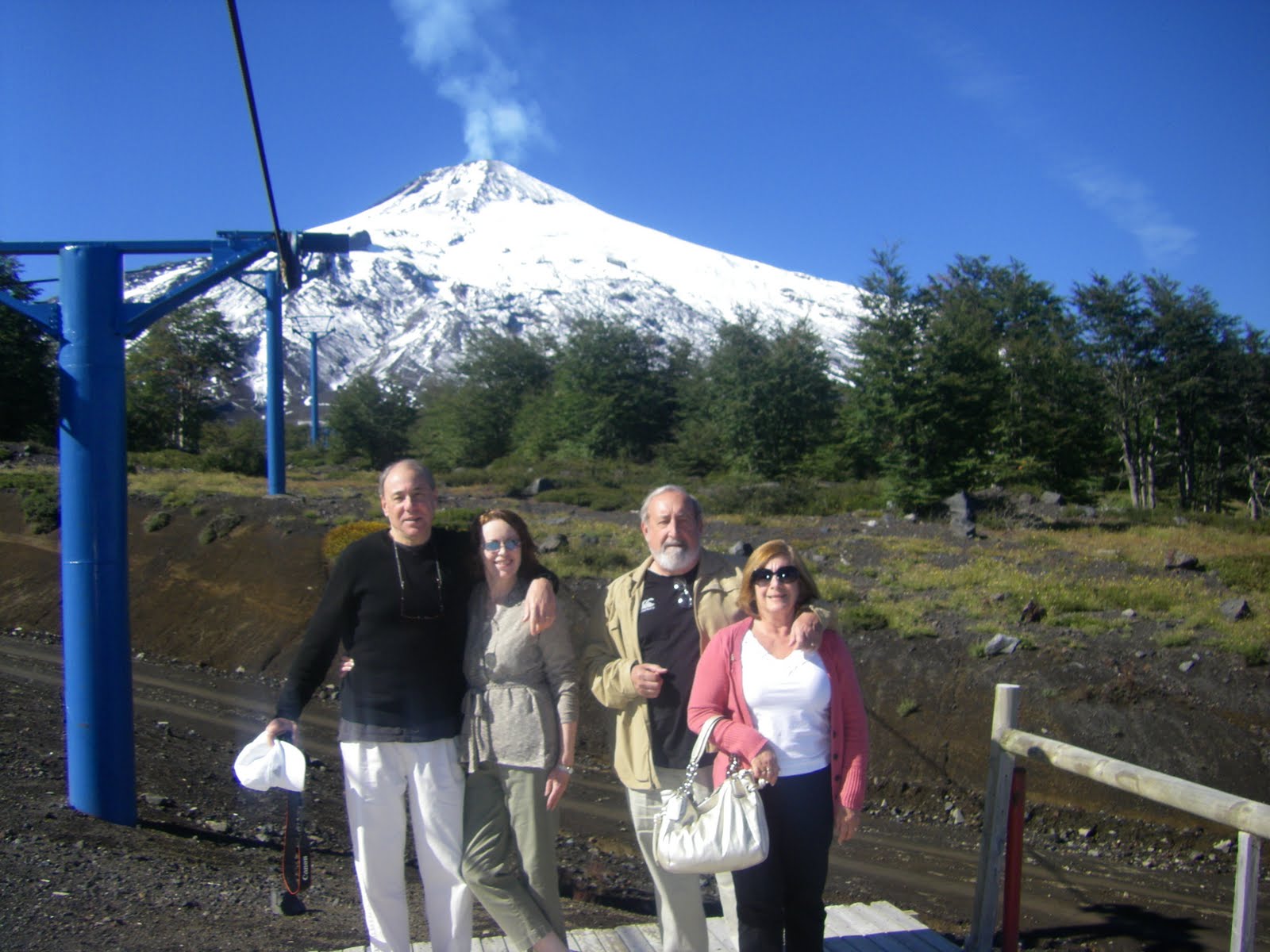
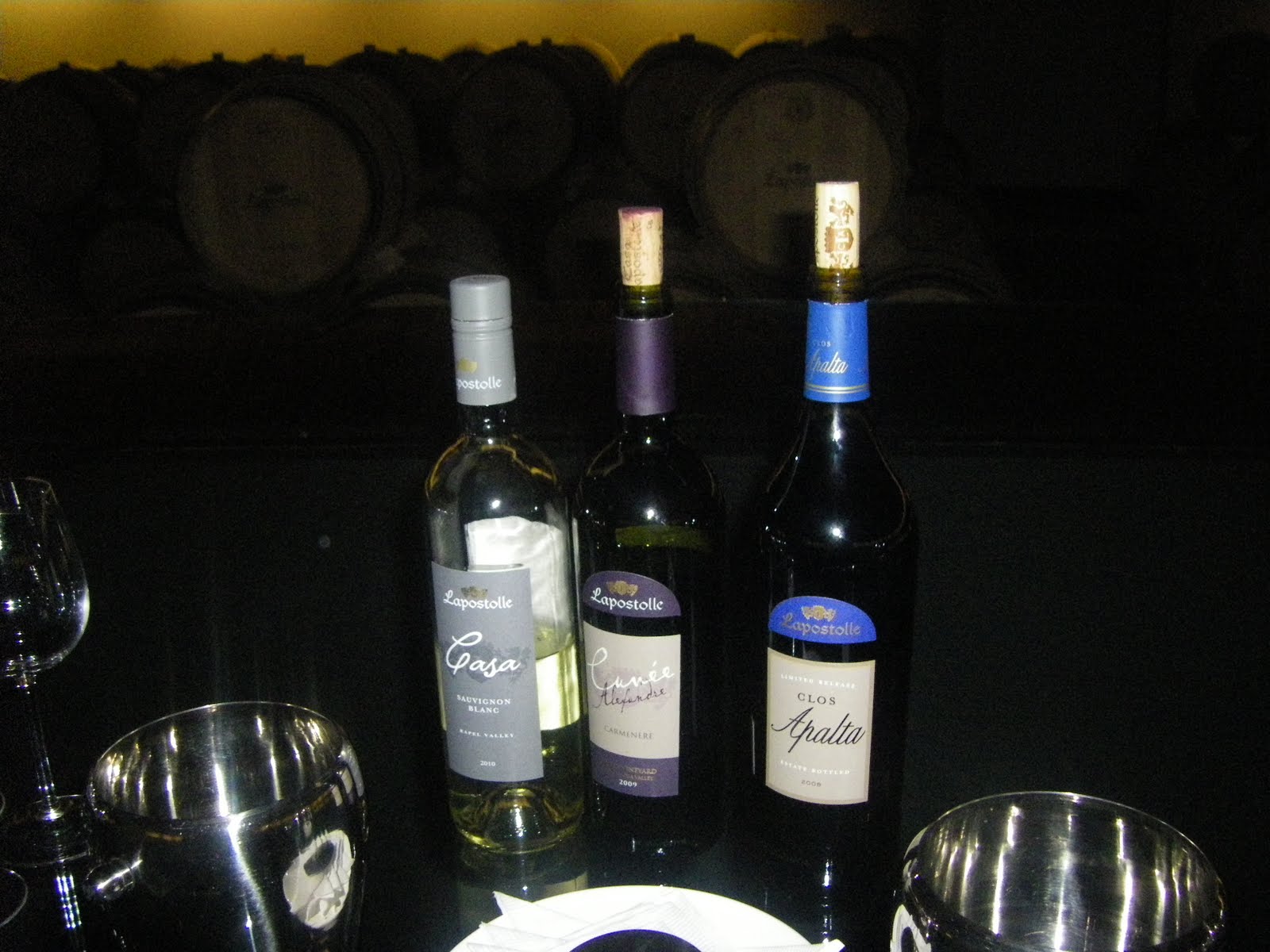
They drank pisco sours at the Chiringuito Restaurant in Zapallar. This is not Mick. It is a Chilean pelican that liked Mick enough to pose for him on a rock next to our table. They enjoyed the picturesque views of the coastal vacation town of Zapallar. We then drove half way down the Pan American highway into the heart of the indigenous homelands of the Araucarians, and shopped in the Temuco market. We walked the shore of Lake Caburgua, well into the Andes mountains where both the past and present Presidents of Chile have their vacation homes. We drank more wine. Actually, we drank wine most of the time, when we were not drinking pisco sours. We awoke one morning to a cloudless day and drove up the side of Villarrica volcano, still active and smoking. Mickey bought three bulls carved out of native Chilean wood, hoping they would influence the US stock market upon their arrival back on Long Island. One was not quite finished, so we waited while the carver placed a set of huge wooden balls on one of Mick’s bulls. We had pisco sours at sunset on the lawn of the Hotel Antumalal, one of the prettiest places in Chile. We then drove back north, into the Colchagua Valley where Mick made two friends at the B&B we stayed in. He was not as successful befriending the nice lady who owns and runs the place. We visited the award winning Lapostolle vineyard. And tasted their best premium wine, Clos Apalta. And finally, we sent them on their way, after two weeks of camaraderie, some political bickering, and lots of fun and good times, back to the US with memories of wonderful Chilean wine, Miles and miles of beautiful vineyards, And lovely Andean sunsets.

NAYA

Finally, I have met Naya. Attempting to meet Nadeschda Del Rio is really why I ended up tossed out of bed, onto the floor at 3:34 AM in the Hotel Alonzo de Ercilla over a year ago in Concepcion, Chile, during that terrible 8.8 earthquake. (You can read all about it in the first posting on this blog, dated May 2010). On that fateful day, my plan was to drive by car to Arauco, a small town south of Concepcion, to visit the widow of an old friend, Enrique del Rio. I worked with Enrique in the Instituto Forestal in 1967 when I was a Peace Corps Volunteer, but I had not heard from or about Enrique or Naya for 40 years. I had finally contacted the Del Rio home in Arauco that day a year ago, before driving to Concepcion, only to hear from Naya that Enrique had passed away 15 years ago. Disappointed by this news, I still wanted to see her, to talk with her about Enrique and to meet his children.

Having aborted this plan to visit Naya in Arauco last year, and knowing that the coastal area south of Concepcion (including Arauco, Lota, Coronel and several small fishing villages) had been seriously damaged and isolated due to the earthquake and tsunami, I have been concerned for the Del Rio family for the past year. As my latest trip to Chile drew to the end, I finally had a few days left in Chile with no commitments and the urge to get out of Santiago for a few days, so I enlisted my old Peace Corps boss and USAID colleague, Gerry (who lives in Santiago with his Chilean wife Maria Elena), to make a visit with me to Concepcion and Arauco to find Naya.

It is a long day’s drive from Santiago to Concepcion and further on to Arauco, so the only stop we made on the way was in Concepcion at the Alonzo de Ercilla Hotel, where I had been the night of the quake. I wanted to see how well they had recovered, since my memory of the place when I left it early the morning after the earthquake was that it had suffered quite a bit of damage. But a year later, the hotel is all fixed and operating as if nothing had happened, so we decided that we would go to Arauco to see Naya, then return to stay at this hotel that night. Gerry insisted, though, that if we did that, we would request a room on the first floor. I had been on the 4th floor in the earthquake, and the first floor just seemed more advisable. The building next to the hotel, which had collapsed into the street during the quake, killing someone in a car parked in the street at the time, was completely demolished. An empty lot now replaces that old building used during 2009 as presidential campaign headquarters for Eduardo Frei. That is pretty appropriate; an unsuccessful campaign, a lost election, a demolished building….three strikes, you’re out!

As we left Concepcion, we crossed the wide, lazy Bio Bio River, and drove right by the ill-fated apartment building which had split in two and partially collapsed during the earthquake, killing several residents and leading to a huge debate and series of lawsuits precipitated by the obvious fact that errors in construction were to blame for this building’s demise. Two taller buildings stood firm right next door, silent witnesses to the crime. We were in a hurry to get to Arauco, so we did not stop to observe closely this landmark building, but agreed we would do so upon our return through Concepcion.

It was getting late as we arrived in Arauco, and we had to search a bit to find the place where Naya had told me a year ago that she lived and was operating her ceramics factory. I had lost the phone number I had used to contact her the year before, so I was not able to call ahead to see if she was there and alert her to our visit. I was just hoping to find her. As Gerry and I drove in a long driveway, past some simple homes and other buildings, we began to speculate as to whether we would even find anyone, since the place was very quiet and we saw no one. However, as we turned a bend in the driveway, Gerry softly whispered “There she is, that must be her standing there…and she is definitely Russian!” Standing in the doorway of what obviously was her ceramics factory, holding a piece of pottery she was polishing, white-blond hair shining in the sunlight, covered with white clay powder from head to toe, stood Nadeschda Mordwinkin Rudenko, my old friend Enrique’s widow.

She smiled from ear to ear when I introduced myself, and honestly, I almost cried as I thought about my old friend Enrique, how he had been so good to me during my first year in Chile as a young Peace Corps Volunteer, how sorry I was he was not there to greet me, and how pleased I was to see Naya after all I had been through to get back to Arauco. Gerry and I toured her ceramics factory, which she and Enrique built 40 years ago but which she is closing down because, at 78 she is tired of working. Besides, the earthquake destroyed the larger of her two ceramic ovens, and she could not repair it. Naya showed us some remaining examples of the beautiful hand painted bowls, dishes, flower vases, and pitchers she has produced for years but which sadly will no longer be on the market. Naya is moving soon to Concepcion to live with her daughter Natasha, where she will teach painting and ceramics in several institutes and schools.

Naya is of a White Russian family that, after escaping from Russia, then from Serbia (Yugoslavia at the time) where they lived in the Diaspora. They arrived in 1948 by boat at the port city of Valparaiso, Chile, with 800 other Russian war refugee families who ultimately settled throughout Chile. She was only 19 when she and Enrique met while living in Penco, a small town just north of Concepcion, and were married. Their six children (Natasha, Maria Alejandra, Maria Cecilia, Eliza, Enrique, and Carolina Nadeschda) and a dozen grandchildren all live in Chile. Naya and Enrique left Chile in 1973, several years after he and I had worked together at the Instituto Forestal in Santiago. She explained to Gerry and me that they left Chile then because they had no desire to go through the civil and social chaos Chile was consumed by at that time as the leftist government headed towards military intervention amidst talks of civil war. Naya especially wanted to leave, since she had escaped as a young girl from what she remembered as similar conditions in Russia and Yugoslavia. They moved to Costa Rica and the United States where Enrique endlessly searched for the right niche to satisfy his independent and creative urge to build his own company, but ultimately they returned to Chile, to Arauco, where Enrique’s family lived and where they built their ceramics factory.

As we talked with Naya about their lives, much of it difficult, struggling to establish themselves in new places, with new languages and new cultures, I could not help but marvel at Naya’s unabated optimism, how creative she has been and still is. I recall some pretty difficult times I myself faced when I went for the first time as a young man to live and work in Chile, but Naya is the kind of person who, without trying, makes me feel guilty to have ever felt sorry for myself.

When we parted after a lovely time together, I became very emotional, as I was when we greeted earlier that afternoon. And I sensed that this very sensitive but life-hardened woman also felt a twinge of nostalgia for times and people in her past awakened a bit by my visit. As Gerry and I drove out the driveway, he said to me “Dave, that was a very nice and meaningful thing to do”. And I felt the same way. In a very small way, I guess I wanted to do something to acknowledge what a good friend Enrique had been to me over forty years ago. I remember how much Enrique admired the United States. I remember the day Enrique entered my office at the Instituto Forestal, shaking, tears in his eyes, having just heard of the assassination in Los Angeles of Robert Kennedy, and cried out “David, what the hell is wrong with your country?” I had no good answer for Enrique that day, but his honest concern for me and for my country helped me greatly that day face up to a very difficult issue and get through a confusing time.

As Gerry and I left the Del Rio home, I deeply wished I had been able to reunite with Enrique before his untimely death, and thank him for his friendship. My efforts to see Naya in Arauco, though, were paid back many times over by the short time I spent reminiscing with this wonderful woman who, during our visit, quietly insisted that “Life is too easy if you don’t find a few stones in the road”. That’s quite an appropriate take on life for a woman whose name in Russian, Nadeschda , means “Hope”.

Thursday, February 17, 2011

Chile in Manhattan

Chile in Manhattan

There are two places in New York City where you can experience Chile. I had heard about both of them, so recently when Ximena and I had a day to explore Manhattan, we decided to check them out. Tucked away on the margins of Chinatown and Little Italy, well-positioned on the corner of Centre and Grand Streets sits “Puro Wine”, and its companion “Puro Chile”. As the name suggests, this is a wine shop with one of the most complete selections of Chilean wine in the US, more than 200 labels from over 50 Chilean wineries. From Santa Rita’s “120”, that we used to drink as Peace Corps Volunteers in Chile over 40 years ago, to Concha y Toro’s top shelf cabernet sauvignon “Don Melchor”, you can find just about any Chilean chardonnay, sauvignon blanc, merlot, carmenere, and cabernet sauvignon. They also have an increasing number of labels of Chilean malbec, pinot noir, and syrah, all newer varieties in the international market from Chile but growing fast in quality and appreciation. And, since over the past few years Chilean vintners have been producing increasingly interesting blends especially of the Bordeaux type, the store sells those too, like Veramonte’s “Primus” (carmenere, cabernet sauvignon, petit verdot), Monte’s “Purple Angel” (carmenere, petit verdot), and Casa Lapostolle’s “Clos Apalta” (carmenere, cabernet sauvignon, merlot, petit verdot).


A visit to “Puro Wine” is accentuated by Lauren’s friendly, well-informed, classy sales pitch. Lauren, the store manager, is not Chilean but she could be. She clearly is committed to Chile and its wines, so she has studied hard at the New York Wine Institute and is travelling to Chile to become the top specialist in Chilean wine she aspires to be. “Puro Wine” offers a pleasant space for social and business events, including frequent wine tastings, so if you live or are traveling in Manhattan you must be on their mailing list so you can participate in one or more of their happy events. Lauren can fix you up at lauren@puro-wine.com.

Around a glass partition is a country brand store with very high quality Chilean products on exhibit and for sale. At the center of the showroom is a showcase with very elegant jewelry made of “crin” (horsehair), which has always been made into decorative artisan products, but these creations, elegant and quite expensive ($110 for a woman’s bracelet), are very, very attractive.
They offer a nice collection of practical sizes of pottery made in a small town an hour southwest of Santiago, Pomaire. This is the dark brown classic pottery that anyone who has lived or traveled in Chile has purchased to serve “chupe de loco” or “pastel de choclo”. These pieces are priced very moderately and if we had not been walking that day we would have purchased several for our kitchen. Chile is now exporting a broad range of packaged gourmet foods, and in “Puro Chile” they offer excellent olive oil, avocado oil infused with “merquen” (that smoky dried chili powder they call “Mapuche Spice” to export to the rest of the world), rose hip jam, and some canned seafood like small clams and crabmeat. Big disappointment though: they do not sell canned “locos” (Chilean abalone), which, if they had it, would probably be prohibitively expensive. The pleasant Chilean woman who attended us gives a very bubbly description of all these products, and does a very good job of representing what is attractive about Chileans in general.

A table with large wooden serving bowls, hand carved from beautiful “rauli”, a reddish wood taken from the disappearing native Valdivian hardwood forests in southern Chile, brought back memories of all the time I spent as a Peace Corps Volunteer in the late 1960s in the lakes and volcano region around Temuco, Osorno, Valdivia, and Puerto Montt. Just a sniff of a “rauli” bowl makes my eyes tear with nostalgia for those happy days when my colleagues and I tramped through those forests collecting wood samples for our projects and then relaxing by a crackling fire in the evenings enjoying great quantities of red wine and increasingly incredible storytelling.
Sharing the space with the wine shop and the artisan store are the offices of “Wines of Chile”, a trade association that promotes wines from Chile’s smaller wineries (www.winesofchile.org). The lounge outside the offices is replete with books about Chile, to peruse or purchase, describing Chilean wines and tourism from the Atacama desert to the fjords of Magallanes. It is a fun and comfortable place to sit, read a bit, remember past times in Chile and dream about future visits. “Wines of Chile” seems to be doing a lot to promote Chile’s lesser known wines, but it would be nice if they did more. All too often I find a paucity of Chilean wines offered in restaurants in the US. Country promotion of wines, such as the successful campaigns waged in the US for Italian and Argentine wines, still eludes the Chilean wine producers. Wines of Chile is making a great attempt at it without much help from the large producers who seem to think they can do better on their own, so I have been told.

One restaurant that does have a whole wine list made up of Chilean wines is a small, homey, comfortable place in Manhattan just a few subway stops up the “C” line, on Restaurant row (46th Street West), named “Pomaire”.
Owned and run by Chileans (and a Mexican waiter the day we were there), this place could have the same name as the other place, “Puro Chile”, because for better and for worse, it is pure Chile. Upon entering you can't but notice the typical naive painting on the wall, showing two huge hands (of God, I presume), one holding the Chilean miners in the mine, and the other assisting the rescuers on the surface.
“Pomaire”, though, is a very appropriate name for this restaurant, reflecting the traditional, almost rustic, laid back ambience of rural Chile and the simplicity of earthy Chilean food. As you would expect, I started with the pisco sour.
It tasted a bit like pisco sour, but for some reason it was clearer than a sour should be, and had a grape and a slice of orange on the lip of the glass, something I think most Chileans would resist doing, not wanting their sour to look too “fruity”. I was surprised by the clarity of the drink, so I asked the Chilean waitress who mixed it, and her Mexican colleague, just exactly how they had made the strange looking drink. I got an explanation that reminded me of so many times over the past 40 years I asked similar questions in Chile. She explained: “The juice was prepared and filtered especially by the owner’s wife late last night, so it would be just right for today’s customers. We didn’t use the egg white called for to make it frothy, because there are so many Gringos who don’t want egg white in their drink, and actually it was made in a very special way just for you because you obviously are an expert on pisco sours!” I probably let on that I was not impressed, neither with the sour nor the defensive explanation, because as I returned to our table, the Mexican waiter whispered to me that if I really wanted a super pisco sour I could get one at “Pio Pio”, the Peruvian Restaurant nearby. I guess even in New York the Peruvians are working harder to win on the age old pisco sour issue. I did not try the Pio Pio Peruvian pisco sour that day, but I would have a feeling it is superior to the “special” one they made just for me at “Pomaire”.

The menu at “Pomaire” is extensive, and pure classical Chilean food: Everything from meat and cheese “empanadas” to sopa de mariscos (seafood soup), pastel de choclo, plateada, bistec a lo pobre, pollo al cognac, and on and on. They do not offer the “one kilo empanada” made famous in their namesake locality back in Chile, so for starters Ximena and I shared a regular size meat empanada.
It was nicely presented and tasty but a stretch when compared to what you get generally in Chile and especially what comes out of Ximena’s kitchen (because she makes the dough a bit thicker and flakier, and she uses diced meat not ground beef for the “pino” filling). But it did have a piece of hard boiled egg and black olive, often left out of inferior empanadas, and did not have too much onion, another shortcoming of some commercial empanadas. For the main dish Ximena ordered cazuela de ave and I, cazuela de vacuno. These very traditional chicken and beef soups (more like stew), were very good, bringing back memories of so many Sunday lunches at Ximena’s home when we were dating. Back then we ate a lot of cazuela, and it is by far my favorite Chilean dish.
Cazuela takes time to prepare correctly, and is best prepared in large quantities enough for an extended Chilean family, so it is one of those classic “slow food” dishes that you see less and less as time goes on. “Pomaire” did not disappoint us with their cazuela, and the ensalada Chilena (onion and tomato salad topped with parsley) was also very tasty, not easy in February in New York, and presented nicely.


Now for a disclaimer, more like an admission. We did not order wine during our lunch at “Pomaire”. I will try to explain it this way, but I know it will not convince the most loyal readers of this blog: The markup on the wines at Pomaire is scandalous. (Ximena reminded me that during our earlier visits that morning we had actually been warned about the high prices of Chilean wine at “Pomaire”). Huge markups on wine everywhere are irritating me more and more these days, but in this Chilean restaurant, where you would think they would be interested in promoting Chile’s great wines as widely as possible, they would resist the “quick buck” temptation. Anyway, we didn’t drink Chilean wine with our Chilean meal, as a way of protesting what I consider unjust markups on something as truly basic to a meal as wine; it is a necessity. I do not remember ever having cazuela without at least a glass of good Chilean wine. And now I am sorry, for in retrospect, I am sure everything would have tasted better with a glass or two of deep, dark Cousino Macul Carmenere Reserva. We also passed on dessert, although they offered “flan casero”, tres leches, and ice cream (very Chilean), not in protest but rather an issue of excessive personal caloric intake.

I certainly would return another day to the “Puro Wine” and “Puro Chile” shops, hopefully timed to coincide with a wine tasting, and to learn about Lauren’s visit to the Casablanca and Colchagua Valleys in Chile. And I think I would return to “Pomaire” for a good “cazuela” or “pastel de choclo”. With the increase in public attention Chile has received as of late, and the way Chile is developing in the global economy, the country deserves a great Chilean restaurant in New York, where one can go to experience Chile, Chileans, good Chilean wines at reasonable prices, and excellent traditional Chilean food. We hope “Pomaire” becomes that restaurant. But, I might try the “Pio Pio” next time too, if only for the pisco sour.

Written in Leesburg, Virginia on February 16, 2011.

Sunday, February 6, 2011

Finding “Jauja”


When I was a young man, serving with the Peace Corps in Chile, I discovered “Jauja”! I remember once standing on the rocky shore of Lago Villarrica in southern Chile, looking out over that beautiful emerald lake with the smoking, snowcapped volcano in the background. I admitted to my Chilean counterpart Enrique, that I had never seen scenes like this before, to which he commented “You are in Jauja, Gringito”. I was told this again one cold, rainy evening while sitting around a crackling fireplace in the Protectora de Empleados Particulares just off the central plaza in Valdivia, drinking warm red wine and eating seafood-filled empanadas with my colleagues from the Instituto Forestal. Upon exclaiming my total pleasure of the moment, Humberto, my boss at the Instituto stated, almost accusatorily, “You have really found “Jauja”, haven’t you Gringo”. For the longest time, I must admit, I did not really know what they meant by “Jauja”. At the time, it did not matter much to me to find out, because when it came up, I was usually too happy and enjoying myself too much with my colleagues to care. Later on, however, in a more inquisitive time, I learned that “Jauja”, while the name of the first capital of Peru, in Chile is a metaphor for prosperity and abundance, or more to the point, an ideal place.

In the interceding forty plus years since I first heard of “Jauja”, I have myself occasionally invoked the term “Jauja” to others. I remember well sitting at an old table behind our Shenandoah Valley country home with Francisco, our Chilean nephew, and shared a bottle of 10-year old Concha y Toro Don Melchor, just the two of us, reminiscing about our lives in Chile and how fate brought us together as family. We bonded a bit more that night, uncle and nephew, in the calm mist of the humid evening and under the soothing effects of one of Chile’s best wines. I stated to Francisco, “You know, this is “Jauja!”. I wasn’t exactly talking about the place, although it was pretty perfect that evening, but more about the mood of our relationship. An ideal place.

And again when a bunch of my Peace Corps buddies and our families stood together on the streets of Santa Barbara, California, drinking cold beer, celebrating the floats in “La Fiesta” parade and toasting our friendship, the day before our oldest daughter Andrea was married. That too was “Jauja”. When you lead an exciting life, have many good friends, and a wonderful family, you tend to have lots of “Jauja” moments.

During the second week in January of this year, Ximena and I travelled to Hastings, New Zealand, to attend the wedding of another Chilean nephew, Francisco’s brother Joaquin, our Godson. Joaquin went to New Zealand about three years ago in a “working holiday” program New Zealand has with Chile. After experimenting with several different jobs, mostly temporary worker jobs like picking fruit, cleaning shellfish, milking cows (you see, New Zealand does not have a border with Mexico), Joaquin found a longer-term opportunity in the wood products industry, made possible because Joaquin, like his father, and like I his godfather, has a university degree in forestry. So he stayed on in New Zealand, much like four decades ago when I stayed on in Chile for a third year of Peace Corps service that culminated in my marriage to Ximena.


As one might expect, Joaquin, a young man, good looking, gregarious, and probably somewhat lonely and nostalgic for his homeland and family, soon found the woman he has been searching for over quite a long period of time, and Laiza and he were married in a lovely Orthodox church in a residential neighborhood in Hastings on January 15. Because I am his Godfather, I was asked to make a toast at the wedding reception. But before that, since we arrived in Hastings several days before the wedding, we were invited to several parties, dinners, and gatherings to meet Laiza’s family and friends. To make things more exciting, Laiza is a Kiwi whose parents are Greek. It didn’t take long to see that the entire Greek community in Hastings makes up Joaquin’s newly found New Zealand family. They all call Joaquin "Joe", signaling a high degree of integration in this English-speaking country, familiarity and permanence, I believe. So of course we roasted a lamb on a spit in the backyard under the expert guidance of Laiza’s father.


We learned Greek dancing, including Zorba’s favorite, so we would not embarrass ourselves at the wedding reception when we would have to spin, kick, and circle all together. We drank too much wonderful New Zealand wine and a good bit of Ouzo. And we even broke some plates, that's required in a Greek party, even in New Zealand.


Joaquin’s and Laiza’s wedding ceremony was traditional, beautiful, and moving.


Through all this, I had been having a difficult time constructing in my mind the toast I would give at the reception. I had almost given in to the easy way out of giving a short, to-the-point congratulatory toast. However, when it came time for me to propose my toast at the reception, I was suddenly inspired by the moment and instead told a story, the story of how young foresters find “Jauja”.

I explained how forty or so years ago another young forester travelled far from his upstate New York home to work for a short period of time in a foreign land where he had no friends (other than his Peace Corps colleagues) and no family. I explained how that young forester, after struggling with a difficult foreign language, a curiously intricate culture, and loneliness, was taken in by a group of caring colleagues and a loving and fun-loving family, how he learned a new language and delved head first into the new culture. In essence, I clarified, he found “Jauja” in Chile. And what’s more, he is still married to Ximena and together they have raised a multi-culture family with close ties with families in both Chile and the US.

Now the God-son is repeating the cycle. Joaquin has been completely taken in by this loving and happy Greek-Kiwi family, and he is a valued employee in his work where his relationship with his colleagues so reminds me of what I had at the Instituto Forestal back in the late 1960s in Chile. Joaquin and Laiza will raise a family that is a blend of Chilean, Greek and New Zealand genes and culture, and the Spanish, English, and Greek languages. That is really how “Jauja” is defined. Just like forty years ago when “El Gringito” found “Jauja” in Chile, “Joe” has found “Jauja” in New Zealand.


Felicidades!! Congratulations!! Sinharitiria!!

Written in Leesburg, Virginia on January 31, 2011

Sunday, January 2, 2011

ADIOS 2010


We entered 2010 calmly planning our yearly trip to Chile. We were looking ahead at a presidential election, a two-week tour of the wine-producing regions on central Chile with Mick and Ceci, friends from Roslyn, NY, and way ahead to the Bi-centennial celebration in September. What already was sure to be an eventful year for Chile soon became an extraordinary one, by all standards. The 8.8 scale earthquake and resultant tsunami on February 27 at 4:30 AM caught me and thousands of others near the epicenter in the sleeping coastal city of Concepcion. While Chile began to recover from the massive destruction, a new President, Sebastian Pinera, was sworn in to the tremors of a strong aftershock that emptied the ceremony of the gathered dignitaries before the ceremony was even over. The quake cancelled our friends’ trip to Chile, and left us all mesmerized at the power of natural events, and the durability of the human spirit.


Within 45 days of the quake, 1.2 million Chilean students were back in their classrooms, within 3 months most basic services were back on in the affected area, and by the time the rains of winter arrived temporary shelter was provided for those left homeless by the disaster. The Chilean economy kept rolling along in spite of the destruction from the quake, with 6% growth for the 9 month period since the swearing in of the new President in early March, more than 200,000 new jobs were created in that same period, and a major educational reform proposal was launched and is wending its way through the political maze towards adoption.

During 2010, confrontation between landowners, security forces, and indigenous Mapuche groups in southern Chile grew violent, resulting in long-overdue attention, but still no resolution, to Mapuche claims of ancestral land ownership and community governance issues. Some believe this issue is so important and so intractable to remain at the top of Chile’s social agenda for some time to come. Towards the end of the year, Chile’s prisons were rocked with violent strikes, revealing a serious underlying social problem begging attention by a society that is truly trying to modernize.


After years of absence from World Cup competition Chile’s soccer team won two matches and made it to the group of 16 in the 19th World Cup in South Africa in June. Ultimately they lost to Brazil, but “La Roja” brought pride back to a country that lives and breathes soccer. By year’s end, though, issues with the Argentine coach of the Chilean national team had the country again predicting problems with their ability to repeat the feat of the 2010 World Cup team.

Just as worldwide media coverage of the Chilean earthquake was waning, the CNN cameras again rushed back to provide minute-by-minute coverage of the rescue of 33 miners trapped for over 2 months 700 meters below the surface in the San Jose copper/gold mine near Copiapo in northern Chile.

Chileans gladly soaked in all this media attention, unusual for this small, relatively quiet country. One of the rescued miners even ran in the NY city marathon draped in the tri-color Chilean flag, closed the NY stock exchange the next day, and that evening sang Elvis songs on David Letterman’s show; his “Spanglish” and stage presence oh so Chilean!

With the 33 miners’ rescue progressing slowly but surely, Chileans took a well-deserved 4-day holiday around September 18th to celebrate their bi-centennial, an energizing event that helped to lift national spirits after a long, rainy, cold winter. But as spring blossomed out throughout the fertile fruit-growing and wine producing central valley, attention turned back to the pace of reconstruction of the earthquake-affected areas. There were growing concerns that the more difficult stages of reconstruction were going too slowly, so new and ongoing initiatives were strengthened, to speed up rebuilding permanent homes, new hospitals, and more schools.

At year end, the President of Chile made a un-precedented public speech to present his accounting of what his administration has accomplished since taking over only 9 months earlier, in March. Reminding us all too much of the debilitating partisan polarization in the US, the leaders of the Chilean opposition coalition, still licking their wounds from the electoral loss to Pinera, chose to snub their President by not attending his presentation.

According to a public opinion poll released at year end in Santiago, Chileans are closing out a very exciting 2010 with optimism. 56% believe 2011 will be “very good” or “good” for the country and 62% believe the same for them personally and their families. According to this survey, they feel safer than they did in the recent past, and much less concerned about being assaulted or robbed in the street or in their homes.
So what is in store for Chile in 2011, if the President’s agenda prevails? According to him, the priorities for public policy are reform of the education and health sectors, elimination once and for all of extreme poverty, decrease in crime rates, modernization of the bureaucracies of State institutions, and a doubling of education scholarships. We shall see.
We began this blog as a way to share our experiences with the February earthquake. Since then, we have meandered through the “Peace Corps”, “Chile’s development”, “La Roca, Dago’s and Maria’s restaurant in Loanco”, and beyond. These themes seem on the face of it quite disparate, but to me they are all connected by what makes Chile so special, the extraordinary spirit of the Chileans themselves. That, coupled with the natural abundance and beauty of the country, continues to suggest that there may be, as President Pinera likes to boast, “The Chilean Way”.


As we watch Chile and Chileans during 2011, we will continue to share some of our experiences and thoughts with you, family and friends, all fine readers of this blog. So, please have a Happy New Year 2011, and stay tuned to DAVESCHILE.
Viva Chile!!!


Written in Leesburg, Virginia, on December 31, 2010.


Monday, December 6, 2010

PLEASE; DON'T FORGET MAULE

The long Chilean winter of 2010 is over, the new Pinera administration is in full swing, the center-left opposition is trying to reorganize after their defeat, the bicentennial celebration is over, and the miners are out of the hole (one was even running in the NY city marathon and closing the NY stock exchange recently). It has been quite a year, for sure but Chileans are already looking ahead, moving on. It seems Santiago is occupied by the hot issues of Mapuche and Pascuense discontent over land ownership, the weak US Dollar and its negative effect on Chilean exports, the urgent reform of the Education sector, and of course the Wikileaks revelation that ex-president Bachelet thought the Argentine President to be somewhat “unstable”. So unfortunately, earthquake reconstruction is fading from view, partially because some of the major infrastructure and basic services problems have been attended to, but also because “Imperial” Santiago tends to forget quickly the suffering and needs of folks in the Provinces.

A quick analysis of recovery efforts in the four key areas of health, transportation, housing, and education is indicative of the situation, now nine months after the quake. Recall that in February with winter almost upon them, the response to the earthquake and tsunami was first, understandably, one of immediate relief for the most affected, provision of a temporary roof over the heads of those left homeless, emergency health care and communicable and water-borne disease control in the affected population, makeshift arrangements so all school children could return to their schoolrooms at the start of the school year in March, and basic clearing and reopening of all major roads and bridges especially along the Pan American highway, “Ruta 5”.

The health situation was greatly assisted by the fact that the winter of 2010 was the most benign in the last four years. Temporary field hospitals were erected almost immediately in the place of hospitals destroyed in the earthquake in the worst affected areas of Bio Bio and Maule. There were no disease outbreaks in Chile over the winter and the general population escaped a serious outbreak of influenza that they had feared would occur. Though health care workers are still attending patients in very crude and uncomfortable field hospitals in some places, there are plans now to rebuild permanent hospitals to replace the ones destroyed. In the meantime nine provisional hospitals, called “Accelerated Construction” will be erected and begin functioning by May of 2011 in Talca(2), Curico, Hualane, Cauquenes, Parral, Chillan, Santiago, and Valparaiso. These provisional structures will replace the field hospitals, take only 90 days to put up, and last 5 years.

The housing sector is much more complicated. The emergency housing efforts, lauded immediately after the emergency, were partially successful in that everyone seems to have been provided at least a medi-agua type structure in time for the winter cold and rains, but these structures and the locations of the temporary camps where they were situated had inherent problems of potable water supply and sufficient waste management and sewage removal, especially in and around the larger towns of Cauquenes, Pelluhue, and Constitucion. The provision of permanent housing is complicated and has therefore been delayed due to the multiplicity of housing subsidy programs that apply depending upon income level and degree of loss, and further complicated by the intention of the national government and some local authorities to prevent reconstruction of housing on high-risk properties in the tsunami affected zones. And the budget authorities to fund the housing programs must be approved by a Congress with a majority of members from the opposition who are taking very seriously their new role of “opposition”. Again, the bottom line is that the programs are moving, but too slowly.

After the earthquake Ruta 5, the main north-south artery over which most passenger vehicle and trucking travel, was damaged in 300 places. Today that has been reduced to 20, but each of these 20 points slows down and adds costs to the important commercial transport that must get Chilean products to market and essential goods and services distributed throughout the country. If this situation lasts through the summer season (January through March) the tourism industry will suffer. The biggest infrastructure job is the ongoing reconstruction of the bridge over the Rio Claro, causing heavy traffic delays in this agricultural, industrial and touristic stretch of Chile.

As I reported in an earlier posting, the education sector received top priority attention from the Pinera government and the Minister of Education, Joaquin Lavin. After an initial suspension of classes for 1.25 million students,45 days after the quake all children were in school. Six months after the quake, 24 million dollars had been made available to repair over 74 schools and 300 day care centers, and erect 30 modular schools for students whose schools were destroyed.


One can only hope that the Chilean authorities will follow through on their promises and pronouncements and follow through on their plans to reconstruct the earthquake and tsunami affected areas of Bio Bio and Maule. Chileans have a right to be skeptical, though, if for no other reason than that too many of the people affected by the earthquake in the northern city of Tocopilla in 2007 are still living in ramshackle temporary shelters awaiting the promised relief from that tragedy. Because Bio Bio has the major city of Concepcion to lead the way, that region will most likely keep clamoring for attention and resources with some success. But the poorer neighboring region of Maule will very probably lag in the reconstruction and rehabilitation process. In this case, it appears that local civil group actions may be the best, most reliable source of assistance.


In Maule, there are many children who have been left homeless, orphaned or living away from their parents, and emotionally damaged by the terrible events they were victims to in February. Their emotional and social needs must be addressed. There are many local faith-based and community support groups that have formed throughout Maule to care for children in need. One organization that has gathered resources in the US to help the poorest and neediest children in Chile by providing resources to these local civic groups is the Chilean American Foundation (CAF), based in Washington DC.


During my visit in September to the Maule region, I went with my brother-in-law, Joaquin, to visit one of the groups receiving funding from the CAF, the Fundacion Mi Hogar foster home for girls in Pelluhue. This Center (and a similar one in Cauquenes also receiving assistance from CAF), do a magnificent job providing shelter, food, education, and love to young children whose parents are unable to care for them due to economic destitution, illness, incarceration, or drug rehabilitation. The children in these centers are so thankful for the little they have, and when I visited I could just feel the energy and optimism they have to confront their daily lives in spite of the lousy hand they have been dealt.


The CAF was approached for support from many more institutions taking care of Maule’s children than they were able to fund. For example, if they had the resources, CAF would provide support to a group of psychologists who have formed a mobile group that regularly visits the schools in Talca, Curico, Cauquenes, Pelluhue, and Chanco, helping small children who show signs of post traumatic stress (violent tendencies, withdrawal, recurrent night terrors, etc.), and help teachers and the children themselves recover from the effects of their tragedy. It isn’t just physical needs these people have…they have to return to a state of psychological normalcy but children, especially, need help to do this. Over the next few months and years, this type of intervention will prove to be highly critical for the young victims of the big Chilean earthquake and tsunami of February 2010. The Chilean American Foundation [www.chileusfoundation.org] is one organization that is following through on their pledge to assist over the long term. My observations in Maule confirm that their assistance is not only needed with urgency, but also greatly appreciated, especially by the children who are trying to put their lives back together in the face of great disadvantage.

Posted on December 6, 2010, in Leesburg, Virginia.