Breakfast on Day six again at the Military Hotel, and we were off on the last stretch of our trip in Chile, for today we were to drive along the south side of Lago General Carrera, and cross over into Argentina at the border town of Chile Chico to begin our long drive north through the Argentine Patagonia. Lago General Carrera is a bi-national lake, 60% in Chile and 40% in Argentina where it is called Lago Buenos Aires.
It eventually empties into the Pacific Ocean at Caleta Tortel via RÍo Baker. The road we wanted to take turned off the Carretera Austral just north of Puerto Bertrand.
 |
| Near Beltrand |
 |
| Lago General Carrera |
The trip along the lake to Chile Chico is an easy, but a bit dangerous, drive. Loose gravel with steep drop-offs can be treacherous, but as long as everyone drives with caution it is one of the loveliest drives in Chile. And Chile Chico is a nice border town, with restaurants and stores for the traveler. Ferries travel across the lake regularly to and from Puerto Ibañez, connecting Chile Chico and travelers with a more expeditious route to Coyhaique. We had our last meal in Chile at the Restaurant Turismo de Chile Chico : crispy but moist broiled salmon, and lukewarm beer.
 |
| Ferry from Chile Chico to Pto. Ibañez |
For the next three days we drove north through Argentina, stopping for the night in Perito Moreno, San Carlos de Bariloche and San MartÍn de Los Andes, before crossing back into Chile through the Mamuil Malal pass at the foot of magnificent Volcan LanÍn, then through Pucón, Villarrica, and eventually back onto the Pan-American highway and home in Santiago. An account of this part of our trip trough Argentina deserves a separate literary effort, left to another day.
We had accomplished our objective of driving from one end of the Carretera Austral to the other; five thousand kilometers through the most beautiful natural areas in the world. Along the way each bend in the road revealed a place, a side road, a trail, a river, a lake, and wonderfully happy people that beg you to stay for days if not weeks, and they especially expect you to enjoy their wonderful land. Our trip was one focused on the pure satisfaction of driving this road as few people have done; certainly most have not traveled the entire length from Puerto Montt to Villa O’Higgins. Instead of what we did, most visitors choose just a section of the Carretera and spend more time exploring the surroundings. And frankly, that is the way to really appreciate this part of Chile, so now that we have satisfied our crude macro-desire, we are already planning longer but more precise visits to more limited areas on the Carretera.
One interesting route is Puerto Montt, Chaitén, Futaleufú, and back through Argentina to Chile at Puyehue, then Osorno. This route is great as long as you traverse the Puerto Montt to Chaitén route by land, including the three barcaza crossings. Another is what most people do; fly to Balmaceda to visit Coyhaique and surroundings, Puerto Aysén, and Laguna San Rafael. But the trip I want to make, and suggest to others, before it becomes too popular, is an extension of this by adding on a visit to Villa O’Higgins for a few days to enjoy that very special place nestled in the Andes right next to Campos de Hielo Sur and Lago O’Higgins.
As I am finishing up this rambling account, the Santiago newspapers are filled with news and opinions on the World Court’s recent determination regarding the Peru-Chile border almost five thousand kilometers north of Villa O’Higgins. Chileans seem distraught over the possibility that Peru, with their legal challenge, might have accomplished wresting some of Chile’s maritime economic exclusive control over a portion of the Pacific Ocean 80 kilometers off the coast of Arica. Probably there are important geopolitical issues at stake, so I am not suggesting Chileans should not be concerned; maybe they should even be more upset at the outcome. What I am wondering, though, is how attentive the Chilean authorities are to the vast terrestrial and maritime riches along the entire length of the Carretera Austral we just visited, as well as further south to and beyond Punta Arenas. Is there serious strategic thinking being forged to guide development of the areas along the entire Argentine-Chilean border that runs the length of the country, but especially in the southern Patagonia region we just visited? Is the next “surprise” of challenged or even lost patrimony going to be in the south due to a lack of serious national presence, protection, and development in the border area?
On one of our last nights on the Carretera Austral, we happened to be staying in the same hotel as the mayor of Villa O’Higgins. We had seen the new housing developments in Villa O’Higgins, and other effects of the opening up of the Carretera, and I, for one, thought that the mayor would be excited about the prospects for his town and the area now that the Carretera is finally being finished. However, to my surprise he divulged very deep-felt anxiety, and disappointment, with the Santiago-centric Chilean national authorities, who, to paraphrase, “…have never paid nearly enough attention to the challenges of developing and defending the incredible natural resources held in trust in the south of Chile, not the present ones, not the prior ones, nor any before them ”.
Maybe now a new government, helped along by the impact of the Peru-Chile border issue, will figure out how to provide the incentives necessary for serious investments in the distant regions of Chile, especially the “deep Patagonian south”. The Carretera Austral, a mammoth undertaking to be sure, is just the first step in a process whereby Chileans begin to take full advantage of their rich natural endowment. My hope is that they follow through with careful development of the entire area through which we travelled on the Carretera Austral, by committing to a model of development that encourages increased economic activity while preserving the vast protected areas of the national parks, reserves, wild rivers and lakes which can attract lucrative tourism and sustain in the long run any human settlements.
In the meantime, good readers, my suggestion is that if you ever wanted to travel the Carretera Austral in Chile, you should do it NOW!

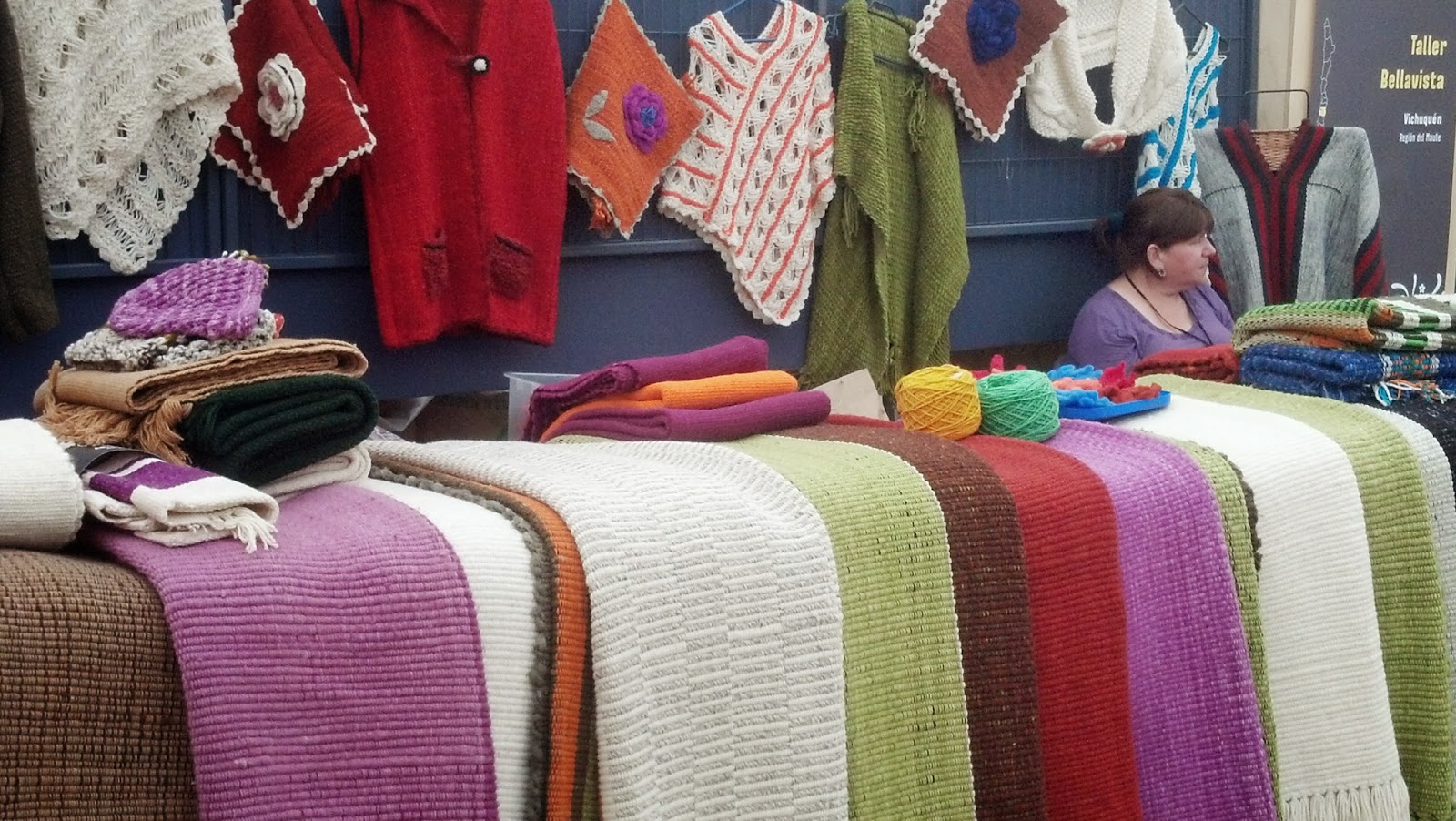
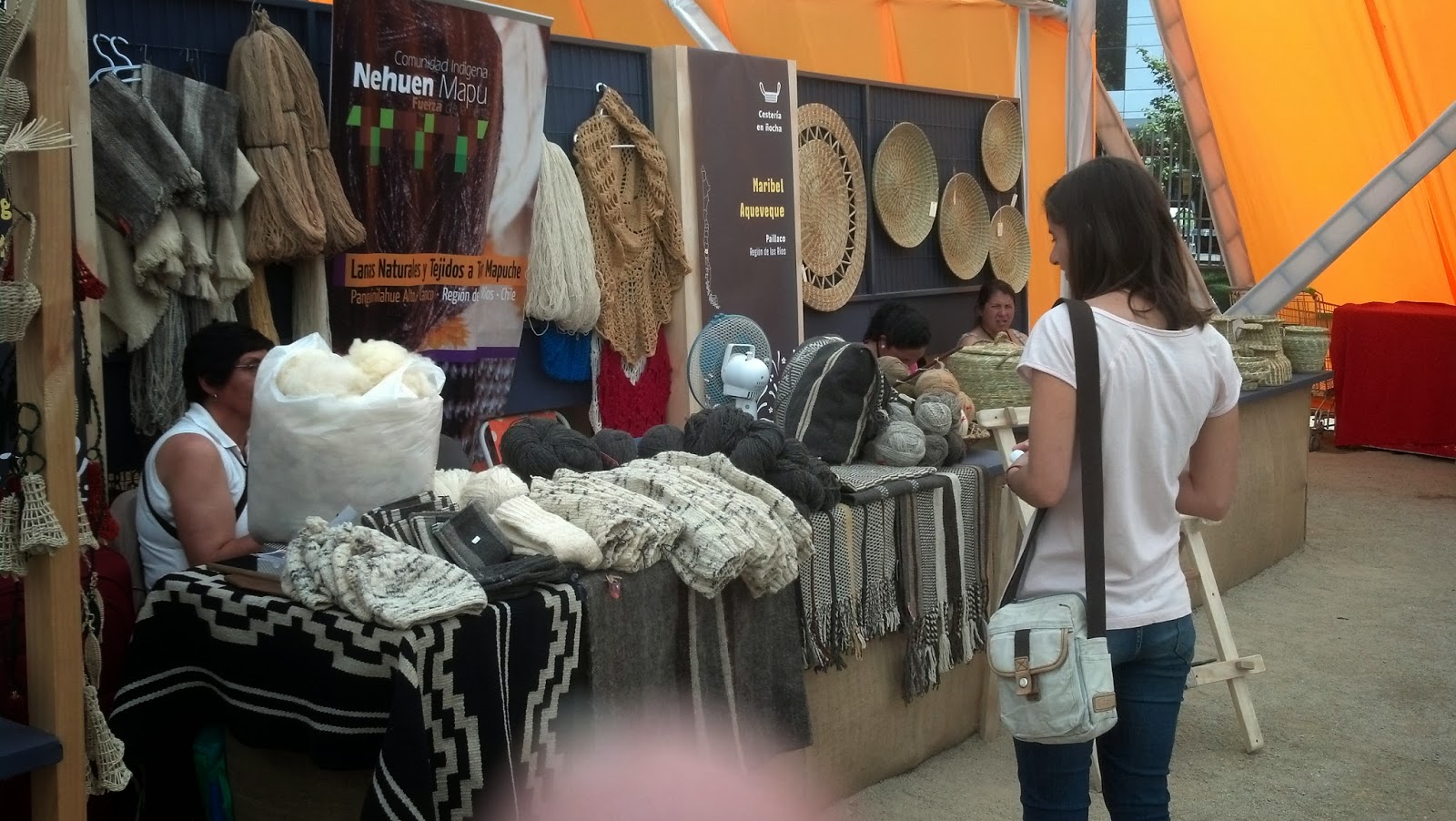
 To begin with, the woven products were exceptional. The Mapuche, indigenous inhabitants of the
Araucanía Region of central-south Chile, have for decades
produced colorful blankets, rugs, and ponchos.
For visitors to Chile, these goods are often the artisan product most
sought after, and a trip to the central market in Temuco was a must.
To begin with, the woven products were exceptional. The Mapuche, indigenous inhabitants of the
Araucanía Region of central-south Chile, have for decades
produced colorful blankets, rugs, and ponchos.
For visitors to Chile, these goods are often the artisan product most
sought after, and a trip to the central market in Temuco was a must. 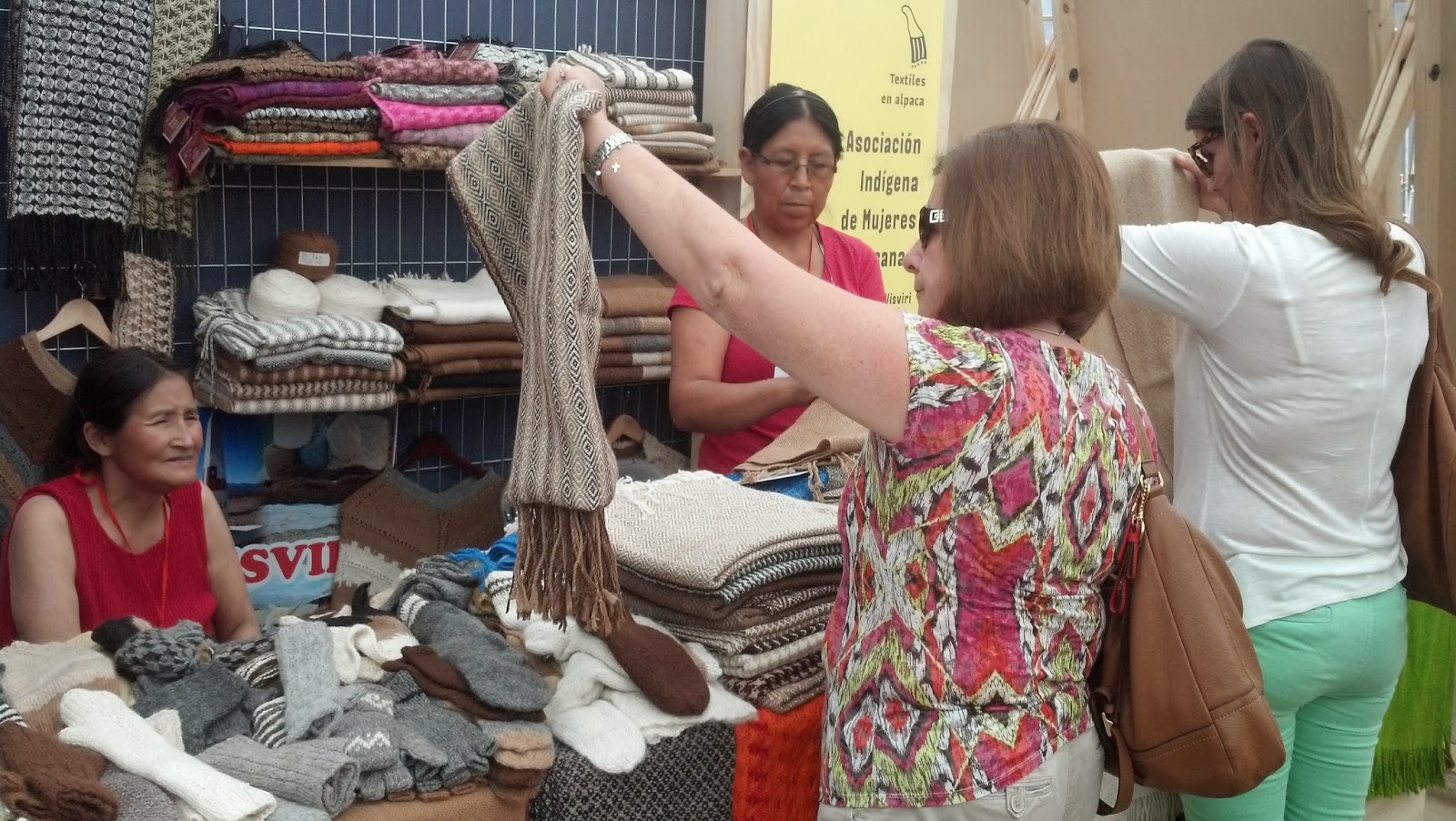
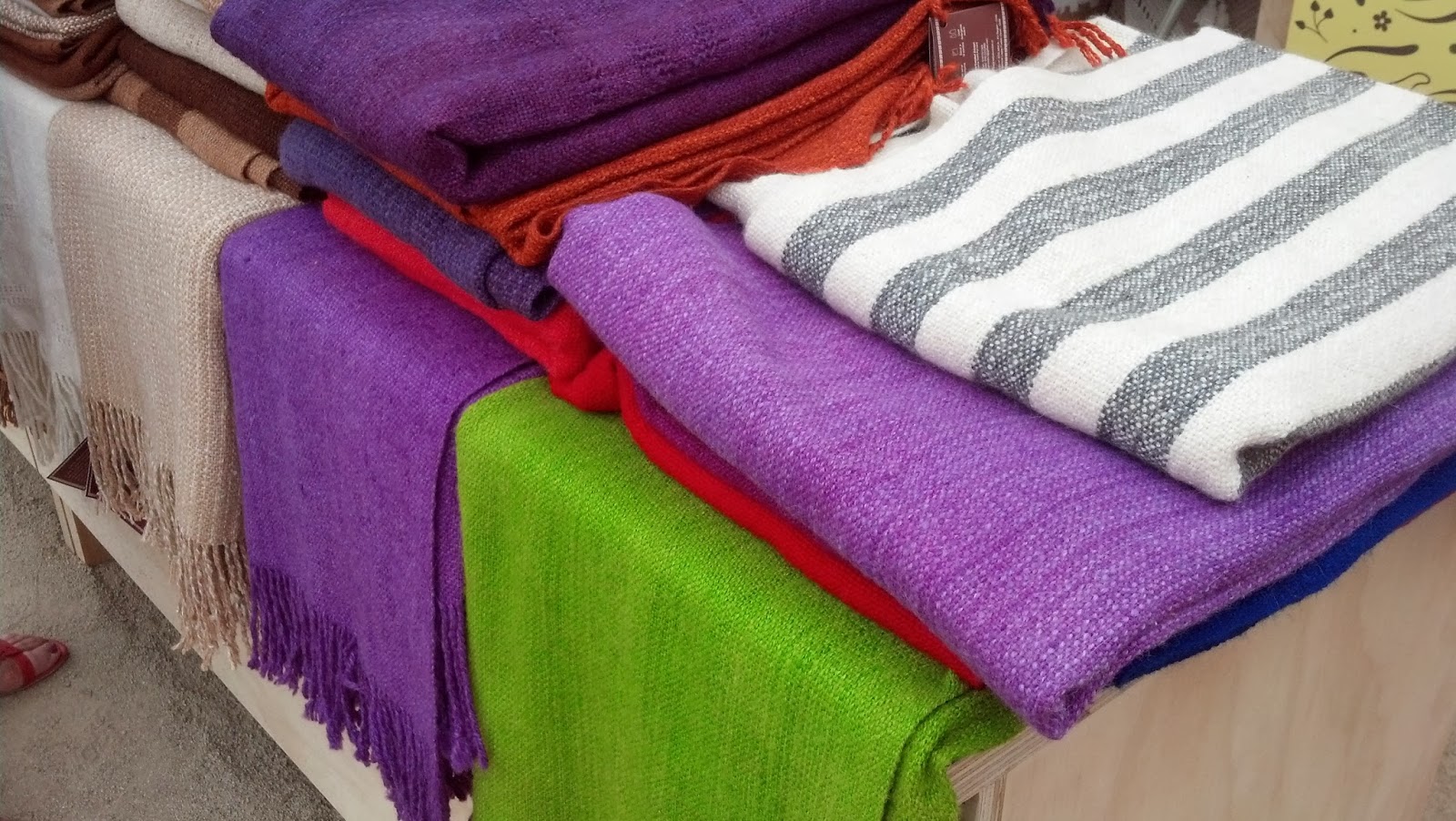
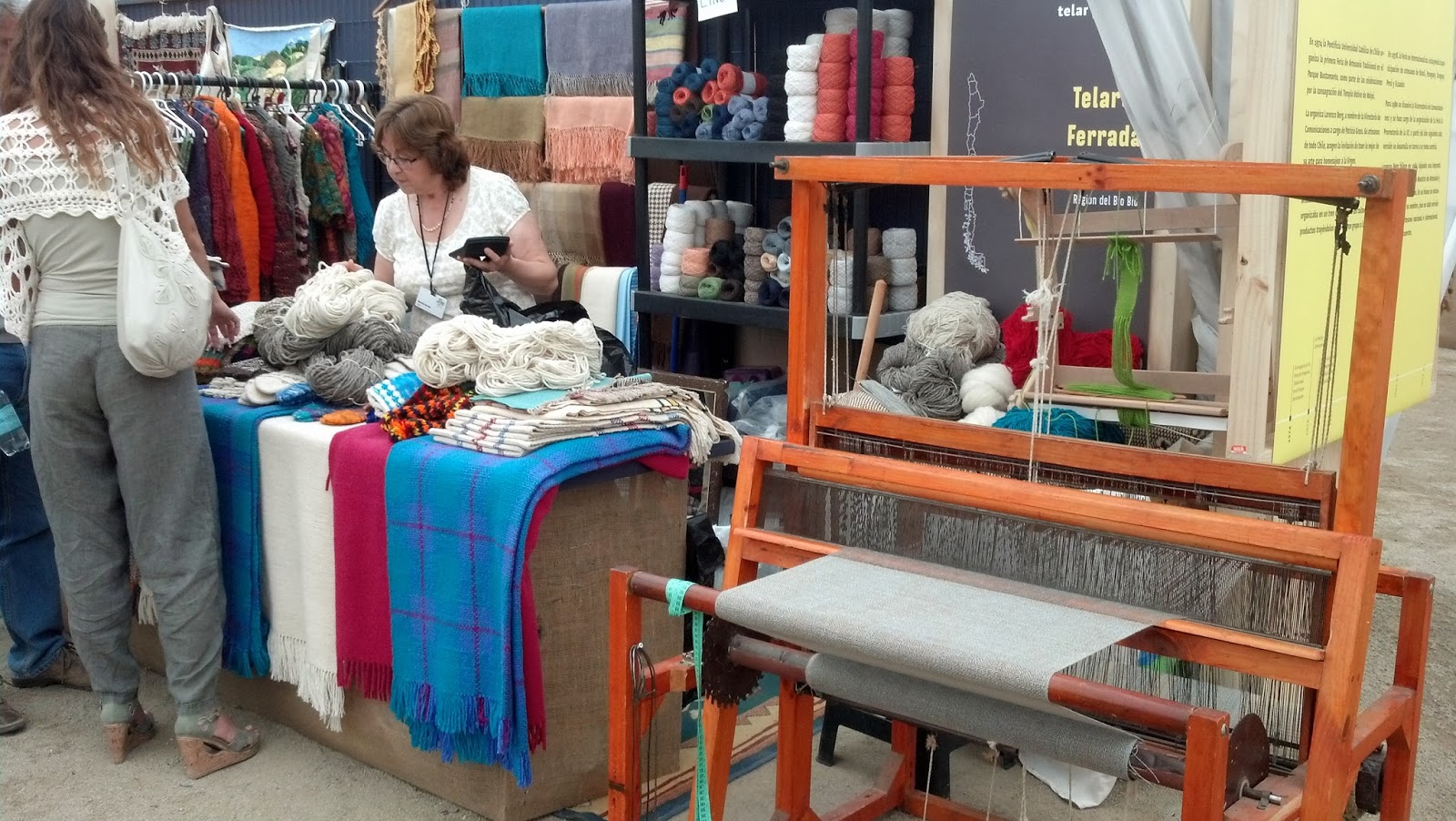 Other colorful weavings, now mostly wool, but also some
alpaca (the relative of the llama and
the Vicuña), have long been made in villages in Chiloé Province, on both the Grand Island of Chiloé (Ancúd, for example) and the
mainland (Chaicas for one) through which the new Carretera Austral passes on
its way to Chilean Patagonia. Maria Iris villarroel, a weaver from Chaicas, revealed to me how they get the vivid colors of green, grey, orange, and yellow in their blankets: for the green, they soak the wool in water with heartwood from the canelo tree; for grey, they soak the stems of the nalca plant with the wool; the orange color is produced by the juice left after making chicha (cider made from grapes); and the yellow from onion skin soaked in water with the wool. A very
different style of weavings is produced by the Aymará in the far north desert region, in places like Colchane in the Tarapacá Region.
Other colorful weavings, now mostly wool, but also some
alpaca (the relative of the llama and
the Vicuña), have long been made in villages in Chiloé Province, on both the Grand Island of Chiloé (Ancúd, for example) and the
mainland (Chaicas for one) through which the new Carretera Austral passes on
its way to Chilean Patagonia. Maria Iris villarroel, a weaver from Chaicas, revealed to me how they get the vivid colors of green, grey, orange, and yellow in their blankets: for the green, they soak the wool in water with heartwood from the canelo tree; for grey, they soak the stems of the nalca plant with the wool; the orange color is produced by the juice left after making chicha (cider made from grapes); and the yellow from onion skin soaked in water with the wool. A very
different style of weavings is produced by the Aymará in the far north desert region, in places like Colchane in the Tarapacá Region.  They aren’t exactly woven, but Chilean artisans have
produced embroidered art, one of the most well-known being the embroidered wall
hangings, about the size of a small window, that depict in the naïve mode,
stories or real life scenes, produced in Isla Negra (one of Pablo Neruda’s home
towns on the Central Chilean coast).
They aren’t exactly woven, but Chilean artisans have
produced embroidered art, one of the most well-known being the embroidered wall
hangings, about the size of a small window, that depict in the naïve mode,
stories or real life scenes, produced in Isla Negra (one of Pablo Neruda’s home
towns on the Central Chilean coast). 
 This is the home of the famous three-legged pig, made from dark brown
clay. Popular then, were the plates,
cups, mugs, and individual pailas,
small bowls used to bake pastel de choclo,
pastel de papas, and chupe de locos. These very practical and inexpensive items
are still made today and were in the exhibition. Today they are just as popular,
but Pomaire has suffered the fate of so many previously popular artisan centers
overrun by tourists and invaded by cheap, trashy souvenirs that have nothing to
do with the place itself.
This is the home of the famous three-legged pig, made from dark brown
clay. Popular then, were the plates,
cups, mugs, and individual pailas,
small bowls used to bake pastel de choclo,
pastel de papas, and chupe de locos. These very practical and inexpensive items
are still made today and were in the exhibition. Today they are just as popular,
but Pomaire has suffered the fate of so many previously popular artisan centers
overrun by tourists and invaded by cheap, trashy souvenirs that have nothing to
do with the place itself.
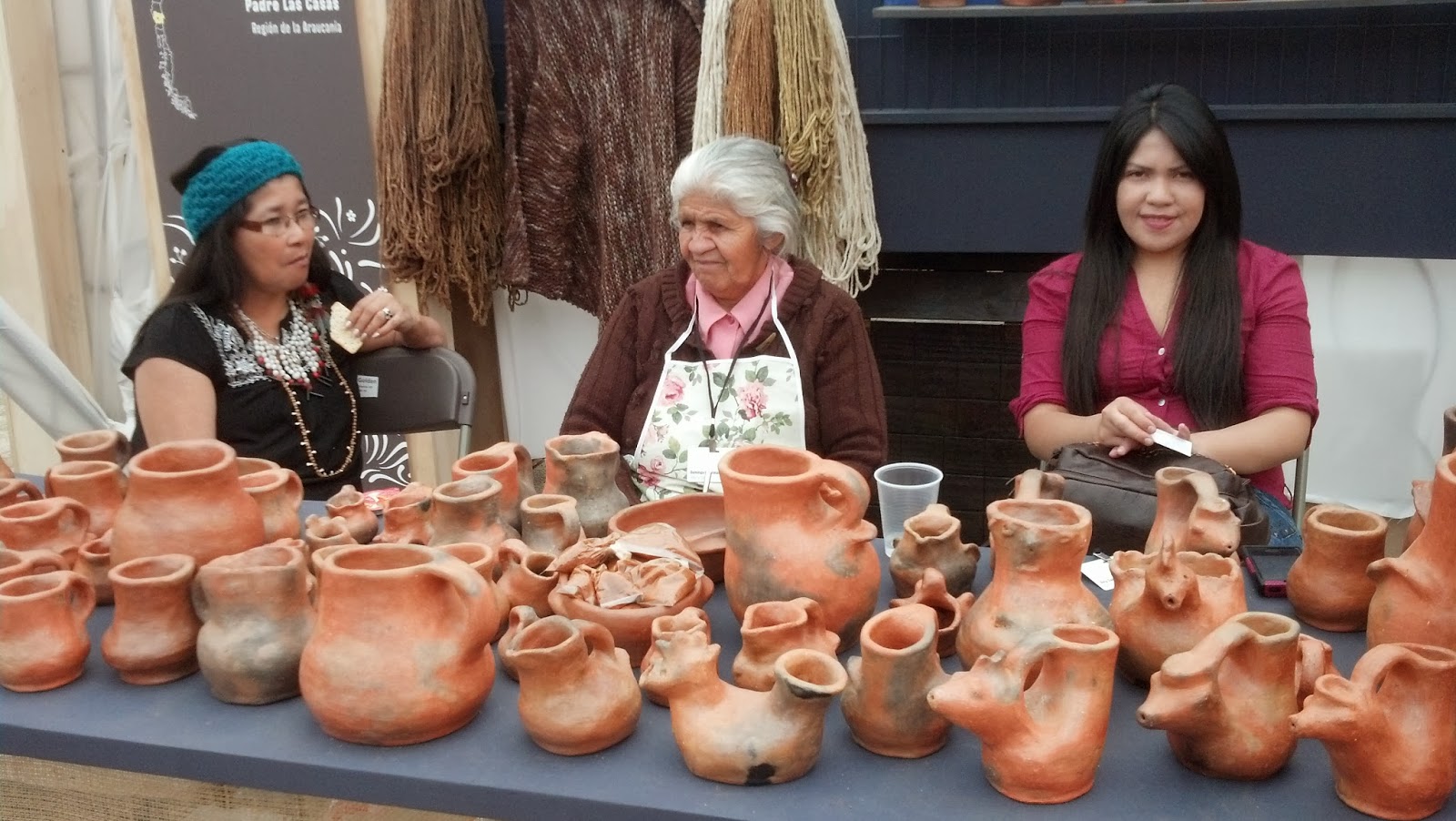

 Besides pottery from Pomaire, there are now very attractive
ceramic offerings now from Vichuquén in the Maule
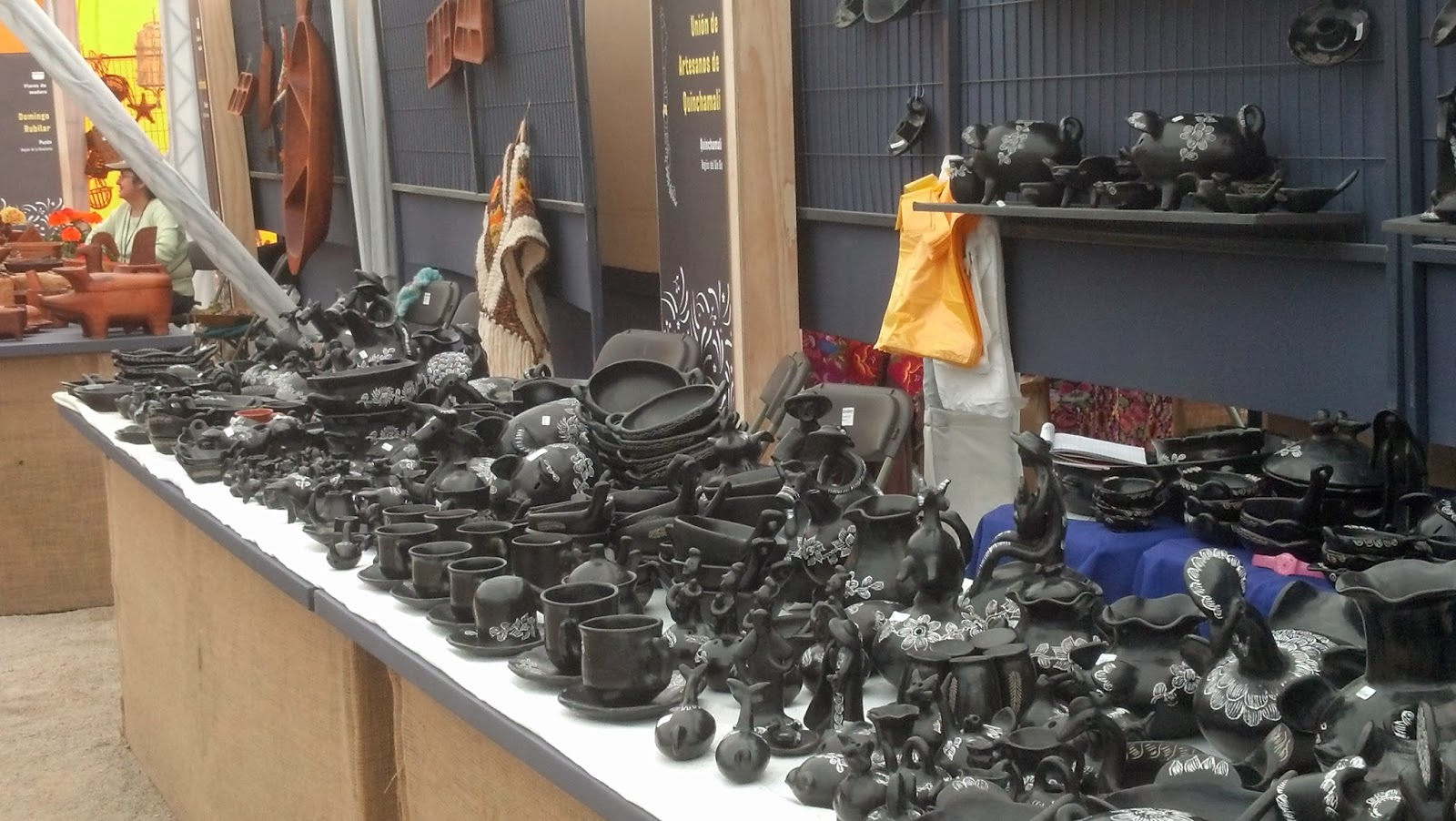
region of Central Chile, and Gorbea and Padre las Casas in the south. Of course the traditional black with white
Quinchamalí pottery
is still being made in that town near Chillan, and is still very popular. Diaguita designs from that earlier
civilization, adorn pottery made in the 4th region of Chile, in what
is called the Norte Chico, or small north.
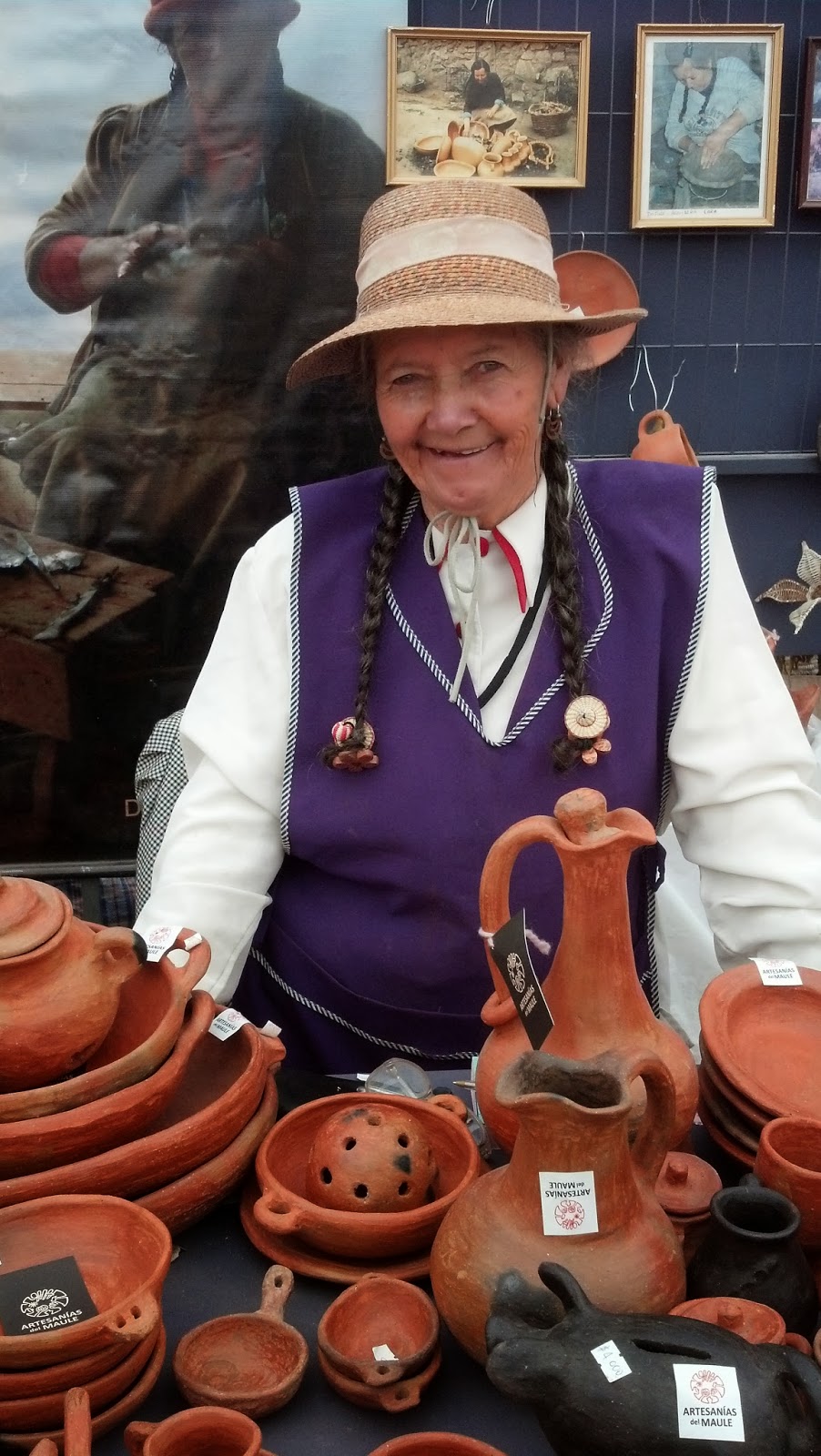
A most interesting potter in the exhibit was Delfina Alguilera, an aged
producer of very rustic style of pots.
She lives outside of Cauquenes, a mostly agriculture town in a very
rural and quite poor area, where due to the rich clay soil in the area, large
brick making operations produce building materials that match, in color,
Delfina’s pottery. She told me she
wouldn’t miss participating in the exhibit since it is her only “outing” each
year.
Besides pottery from Pomaire, there are now very attractive
ceramic offerings now from Vichuquén in the Maule
region of Central Chile, and Gorbea and Padre las Casas in the south. Of course the traditional black with white
Quinchamalí pottery
is still being made in that town near Chillan, and is still very popular. Diaguita designs from that earlier
civilization, adorn pottery made in the 4th region of Chile, in what
is called the Norte Chico, or small north.
A most interesting potter in the exhibit was Delfina Alguilera, an aged
producer of very rustic style of pots.
She lives outside of Cauquenes, a mostly agriculture town in a very
rural and quite poor area, where due to the rich clay soil in the area, large
brick making operations produce building materials that match, in color,
Delfina’s pottery. She told me she
wouldn’t miss participating in the exhibit since it is her only “outing” each
year.

 And of course you can still buy cute items made from crin, or horse tail hair. Some are
actually useful, like the Christmas tree ornaments, coasters for glasses, and
book marks, and they are great gifts to take to distant friends and family
because they weigh almost nothing and take up no space. Stone mortar and pestle sets, modeled after
the ones used by early inhabitants to mash grain, garlic, dried hot peppers,
and anything else that required grinding into powder, make a great gift, if you
don’t have to transport it very far, since it is bulky and heavy, of course.
And of course you can still buy cute items made from crin, or horse tail hair. Some are
actually useful, like the Christmas tree ornaments, coasters for glasses, and
book marks, and they are great gifts to take to distant friends and family
because they weigh almost nothing and take up no space. Stone mortar and pestle sets, modeled after
the ones used by early inhabitants to mash grain, garlic, dried hot peppers,
and anything else that required grinding into powder, make a great gift, if you
don’t have to transport it very far, since it is bulky and heavy, of course.
 If you have travelled south of Santiago on the Pan-American
Highway, you most certainly have noticed the handmade brooms sold along the
road near Rengo, and the two kilometers of stores selling mimbre (woven strips of willow wood) furniture in Chimborongo.
If you have travelled south of Santiago on the Pan-American
Highway, you most certainly have noticed the handmade brooms sold along the
road near Rengo, and the two kilometers of stores selling mimbre (woven strips of willow wood) furniture in Chimborongo.


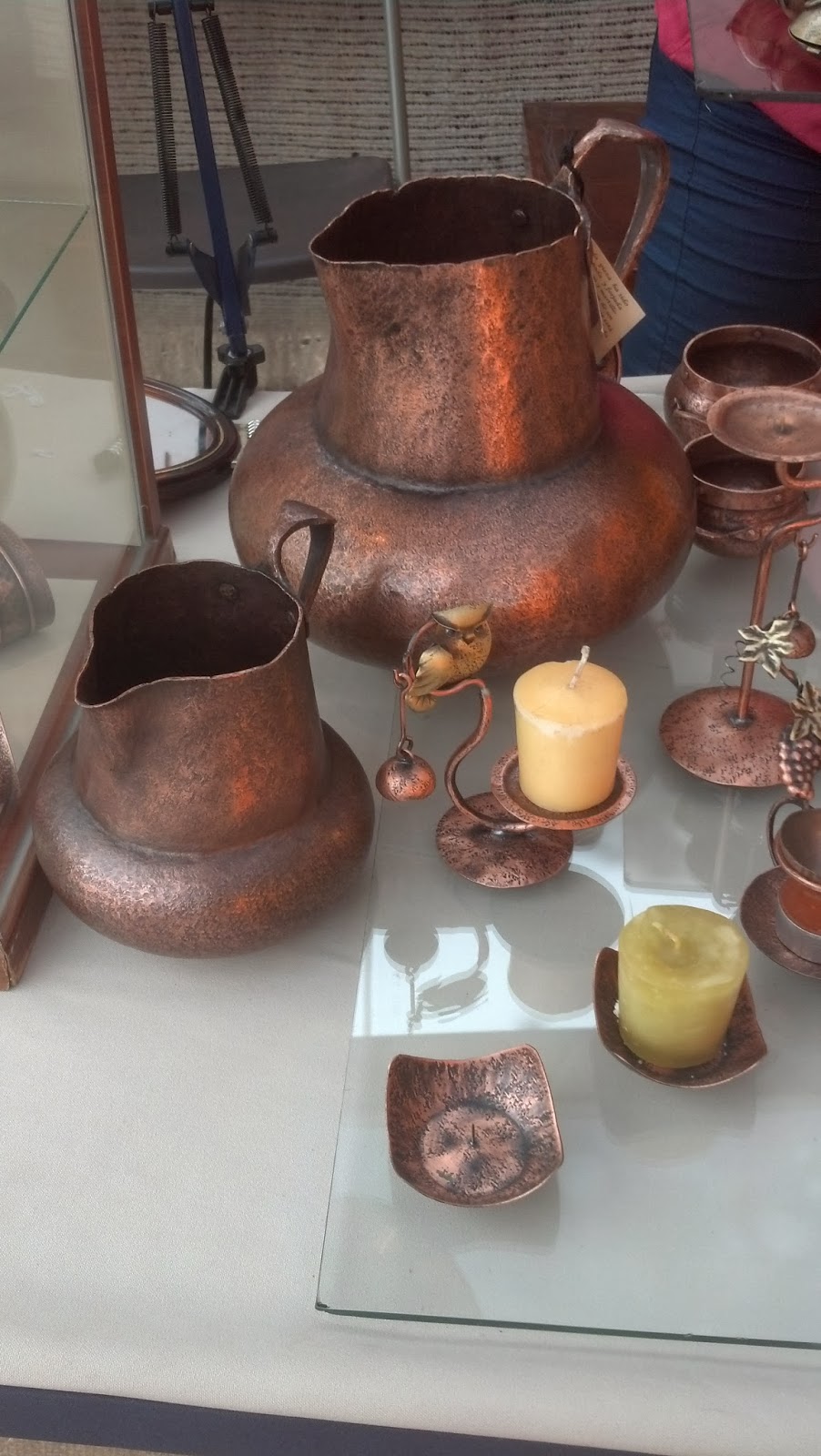
 Copper jewelry, trinkets, and costly artefacts get more and
more interesting as time goes on.
Copper jewelry, trinkets, and costly artefacts get more and
more interesting as time goes on.

 The leather and metalwork that goes into all
the equipment a Chilean horseman needs for himself and his horse are still available,
but indeed scarcer as rural Chile and the domain of the huaso give way to urban habits…and Audis.
The leather and metalwork that goes into all
the equipment a Chilean horseman needs for himself and his horse are still available,
but indeed scarcer as rural Chile and the domain of the huaso give way to urban habits…and Audis.

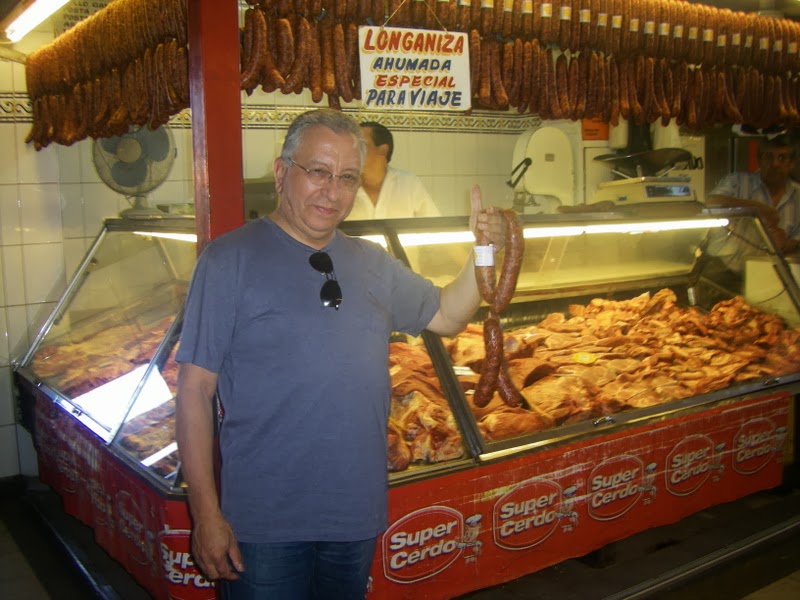
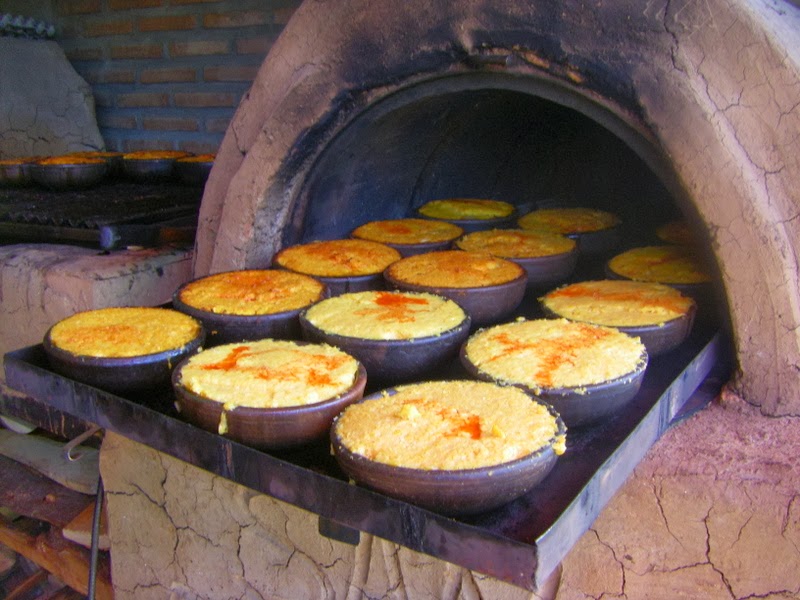
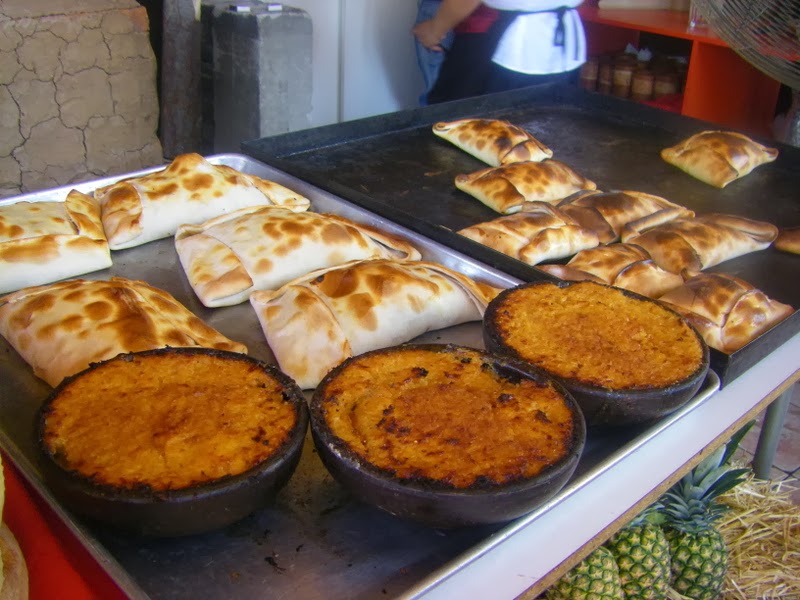
 Ah yes, I almost forgot to mention, in the context of
traditional Chilean artisan products, the old favorites of the empanada, the pisco sour, the longaniza
from Chillán (hopefully from los Pincheira; the
sausage-making Pincheiras, not the outlaws),
and a big glass of cool mote con
huesillo.
Ah yes, I almost forgot to mention, in the context of
traditional Chilean artisan products, the old favorites of the empanada, the pisco sour, the longaniza
from Chillán (hopefully from los Pincheira; the
sausage-making Pincheiras, not the outlaws),
and a big glass of cool mote con
huesillo.