Sunday, March 25, 2012

The Three Sisters

Once in a while a book gets written that reflects so accurately things we have done, places we have visited, and people we have known, that , rather than read it, we experience it. One for the Road, by David Mather, is for me just such a book. My Peace Corps experience was in the same country, Chile, at the same time, and with some of the same people featured in the story, including Mather’s (and my) friend “Oso”, who to this day continues to be a very good friend; and he is still an “Oso”, a bear of a man. Reading this book, a novel actually, I relived many of my visits to Valdivia, the carousing with Chilean friends, the headaches and hangovers, the long meals with “Oso”. Mather’s story isn’t exactly the same as mine. He would go into town and head for the Bomba Bar downtown,
while when I visited Valdivia with my forestry colleagues we would stop first at the “Guata Amarilla”, a rustic grill alongside the river on the outskirts of town, before heading to the Hotel Schuster to have one of the best pisco sours in Chile. Some differences, but the Valdivia Mather describes as his, is also mine.

One For The Road brought back deeply hidden memories of nasty Chilean free ranging campo dogs, SAG’s visionary reforestation program, the rich smell of a cook stove stoked with firewood from the native forest, empanadas fresh from the horno de barro, and waiting…waiting…waiting for someone to show up.

Mather’s main character in his story, Tomás, lived with a family in the small rural settlement named La Colonia de Cufeo, when he arrived in Chile for his two-year assignment with the Peace Corps. If you have ever spent much time in a place where you do not speak the local language, or at least not very well, you know that you are pretty much left out of most conversations, sometimes even totally ignored, but for the saving grace of lovely, open minded, inquisitive children.

During the first year I lived in Santiago, speaking Spanish like a 3-year old, my most frequent and informative conversations were with 4-year old José Luís and his two slightly older sisters. These kids, neighbors of mine, thought my Peace Corps colleague and roommate Tom and I were great entertainment. They would come to our street-side window, which we opened to let the sunlight into our cave-like apartment, climb up on the sill, and “talk” to us. We gave them comics from the newspapers, and candy. They asked us simple questions like “How many cars do you have?” “Do you know superman?” “What’s that stuff you are putting in your pipe that smells so sweet?” “Why are there so many empty bottles on your table?” Very good questions. Great fun. I have often wondered what ever happened to José Luís and his sisters. They are now about 50 years old or so, probably have families. It would be nice to know.

Mather’s fictional Peace Corps Volunteer, Tomás, lived with three young sisters in Cufeo, and his story is similar. These young girls were at first the only people who would talk to him. The older folks took a lot longer to relax and warm up enough to try a comment or two. But he learned about small things like when to pick the wild fruit called chupón, and big things like the prevalence of sexual abuse in rural Chile, from his “little sisters”. And in spite of the friendship that developed, when he went home to the US after his service had ended, he probably lost track of these wonderful welcoming Chilean kids who taught him so much, especially the value of caring.

Just before taking off on one of my recent trips to southern Chile, I asked Mather if there were, by chance, any of his “fictional characters” in One For The Road who might exist in real life whom I could visit. He had said in the preface to his book that while some of the characters in his novel were based on real people, they all had been given fictional names except for “Oso”. He told us that if we followed his instructions, we might be able to find the three sisters PC Volunteer Tomás lived with in Cufeo. So we went looking for the three sisters, Rosa, Ana and little Lilia in the book; Sonia,Irene, and Mila in real life.

We drove out of Valdivia, onto Teja Island, past the campus of the Austral University and the large tourist trap that is the Kunstman Brewery, arriving eventually in Niebla, a small town at the mouth of the Calle Calle River across from the Spanish fort at Corral. All summer in Niebla there is a very funky Chilean tourist type thing called the “Encuentro Costumbrista Playa Grande, Niebla, Valdivia” where they have set up a large stage and surrounded it with tiny little restaurants and vendors selling anything from Kuntsman beer to apple cider they call chicha dulce everything you need to make a Chilean Cowboy (huaso) outfit. The little restaurants serve seafood empanadas, beef shish-ka-bobs, and asado al palo (lamb on a spit). We timed our arrival to lunchtime just for that reason.

When we arrived, they were playing recorded traditional music, but shortly after we arrived a series of live folk groups began to play all types of popular music, including the National dance, the cueca. Our objective was to find at least one of the three sisters, and finding them was becoming urgent because we were hungry and Mather had told me the sisters have two food stands here at the “Encuentro”. We started asking for the Montoya sisters (their maiden name when Tomás lived with them in Cufeo in One for the Road). We lucked out immediately. We found Irene(Ana) with her husband, her son Boris and Mila’s(Lilia) daughter Yohana serving roast lamb in a stand right across from the stage. Irene was ecstatic to meet someone who had been in the Peace Corps and she took us right away to meet Sonia (Rosa) who along with her husband Hernán runs another stand that also serves roast lamb. We had a great time with these little sisters from Cufeo.


More than 45 years have passed since a Peace Corps Volunteer lived in their home, and life in the rural south of Chile is not easy for men or women. But, while older and stouter, these sisters have not lost a bit of their bubbly, open, sincere nature. Irene and Sonia argued over who would feed us their roast lamb. We told Sonia and Hernán we would be back later to test theirs, and went to Irene’s place to have lunch. After all, we found her first. Flick and I sat down pretty sure the roast lamb plate Irene had offered us would be just too large for us to finish, so we thought we would be clever and ordered a cazuela.


That’s a beef stew-type dish we often order and knew we could at least finish that. The generosity of the Montoya sisters is something to behold, and we should have suspected what would happen, that “Gringo clever” fades when faced with Chilean hospitality. So, sure enough, as we finished our cazuela, Boris and Yohana plunked down two plates full of roast lamb, beef and boiled potatoes.
We learned long ago that Chileans can be terribly offended if you do not eat the food they prepare for you, so we finished every last bit, took some pictures, listened to some music, resisted getting up on the stage to dance the Cueca, and said long goodbyes to the Montoya family.

The next day as we drove out of Valdivia, heading south towards Osorno and eventually Chiloé Island, Flick and I talked a lot about the people we knew when we lived as twenty-some year old Peace Corps Volunteers, like Tomás. The Montoya sisters with their food stands in Niebla encouraged me to think that maybe José Luís, my little neighbor on Calle Luís Beltrán in 1967, might at this moment own a neighborhood restaurant in the Nuñoa section of Santiago. Who knows? Maybe he is a professional soccer player, or a high school teacher. I wonder if he would remember me. I must try to find him.

Along rural roads throughout Chile, especially in the south, there are shelters for passengers waiting for buses to come by to take them to town. We were not far out of Valdivia the day after we had seen the Montoya sisters, when we noticed one of these shelters had CUFEO written on it. We realized that up in those hills, above the shelter, is the stage where the Montoya sisters gave Peace Corps Volunteer Tomás, of One for the Road, the soundest education he probably would ever get.

As we drove by the shelter, I looked back through my rear view mirror, at the roof of the shelter, and the trees surrounding it, to see if there was, by any chance, a condor perched there looking over us. I was a bit disappointed, for sure enough, there was not. I had harbored the thought that since we had found the three sisters, maybe, just maybe, the condor would be there.

Note to reader: The last thought in this story only makes sense if you have read the book, One for The Road, so if you have not, please do so. www.onefortheroad-mather.com)

Posted in Santiago, Chile On March 25, 2012

Tuesday, March 20, 2012

Trovolhue High and Dry

There are many small towns sprinkled throughout the Araucanía region of Chile west of Temuco and along the meandering Río Imperial. One of these towns is Trovolhue, which, on a sunny, warm day in the last week of the 2012 Chilean summer vacation period, was our destination as Flick and I cruised along the busy road south of Concepción.
We were enjoying the miles and miles of forested hills and valleys covering this part of the Bío Bío region, south of the Río Bío Bío between the Pacific Ocean and the Pan American Highway, and north of the Rio Toltén, a vast area relatively unknown to most Chileans and unvisited by tourists.

In spite of the isolation of this area of Chile where the southern Bío Bío region melds with the northern half of the Araucanía Region, from 1962 to 1998 dozens of Peace Corps Volunteers were assigned here to work in reforestation, rural health, and community development programs. Flick and I were Volunteers from 1967 to 1970; he was assigned to a reforestation program in Curicó and Talca, more to the north, and I to Chile's forestry research center, the Instituto Forestal, located in Santiago but operating field projects that took me for long periods of time to parts of the Chilean south. As we drove south from Concepción, we saw signs for many of the places familiar to us as sites where our fellow Volunteers spent the better part of two years: Arauco, Cañete, Curanilahue, Contulmo, and Purén. These towns are all just west of another set of towns further from the coast, where other Volunteers were assigned to coax small landowners to plant trees on very poor land for erosion control and to produce fence posts, construction lumber and firewood: Laja, Nacimiento, Angól, Traiguén, Collipulli and Galvarino.

Our plan this day was to reach our destination, Trovolhue, by early afternoon but we were running quite late. Our departure from El Faro, near Loanco where Flick and I had left Ximena and her mother to spend a quiet week with Ximena’s sister Verónica and her husband Joaco, had been early enough. A Maule breakfast of a big cup of steaming Nescafé con leche, a couple of pieces of hallulla toast smothered with unfiltered, thick, wildflower honey and blackberry jam, a couple of boiled eggs, a piece of Chanco cheese and a slice of salame, and we were off on our week-long adventure. However, our decision to get to our destination that day by going from Chanco to Cauquenes, and then to Concepción along an inland road instead of the coastal road, was a mistake, and an omen of what the rest of the day would hold. Construction on the Chanco to Cauquenes road delayed us for more than an hour, so by the time we finally passed Concepción it was already well after noon.


The last three Chilean Presidents (Lagos, Bachelet, and now Piñera) have all committed impressive amounts of resources to building and rebuilding the infrastructure that Chileans need to move themselves and their products from one end of this long country to the other, to the ports and the urban centers. A key element of this multi-year initiative is the opening up of the many isolated expanses of the Chilean coast where pristine beaches, exciting rocky shores and coastal hillsides have gone unsettled and hardly visited until now. We were traveling, this sunny day in late February, along one of those roads where massive bridges, overpasses, and hard surfaced highways are being built.
When it is all done, it is hard to tell what will happen to this relatively untouched area of the country in terms of development, and destruction, but on this day the main issue for us was that it was taking us a lot longer to get to Trovolhue than we had planned.

We finally reached the small town of Tirúa, about 50 kilometers north of Trovolhue, late in the afternoon. From Tirúa we had two options, a paved road that would take us southeast to Nueva Imperial, from which we could take the main road west to the turnoff and then about 10 kilometers north again to Trovolhue, or a more direct gravel road used mostly by logging trucks, ox carts, an occasional horseman, and dogs who flashed out of the roadside wild blackberry thickets in a futile attempt to run us off the road. We chose the road less traveled, of course, and after about an hour or so of cruising slowly through absolutely beautiful coastal hillsides of forest and farmland, we descended into the town of Trovolhue.

In 1960, Chile experienced an earthquake stronger and more destructive than the 8.8 quake that hit central Chile two years ago. The quake in 1960, centered in the southern city of Valdivia, registered in at 9.5 and killed ten times as many people (more than 5,000). One consequence of this was that the small river that flowed through the town of Trovolhue, situated about 160 kilometers to the north of Valdivia, every year would rise above its banks and flood the town. Flick and I were visiting Trovolhue because one of the prominent stories of the Peace Corps in Chile is that of a small group of volunteers who assisted the townspeople of Trovolhue disassemble their oft-flooded town and move it to higher ground, lock, stock and barrel.

The story goes like this: In 1965, Peace Corps Volunteers helped design a plan to move the town to safer ground. The Volunteers helped obtain the required official approvals and heavy earthmoving equipment and financing to build a new access bridge. They surveyed and laid out the town streets, home sites, and essential services. Public agencies and private organizations all contributed to move 100 families, who dismantled the existing homes and buildings and rebuilt them on the new site. Volunteers worked with townswomen to improve nutrition and health, and to increase income through home-based food preservation and clothes making. After the Peace Corps Volunteers left in 1968, townspeople and the Chilean government continued to improve streets, built a new school and police station, and many more families moved to the new town site.

Like most folklore, which Peace Corps legends often become, there is always the chance that there may be some distance between what actually happened, and the story as it is told decades later.
The story of Trovolhue was featured, along with other notable Peace Corps Chile accomplishments, in a picture poster at the 2011 reunion in Washington, DC, for Peace Corps Volunteers who had served in Chile from 1961 – 1998. To tell the story of how Volunteers Brian, his wife Sharon, and Phil helped move Trovolhue to higher ground, Kay, another Volunteer who had served in the region at the same time, provided pictures she had taken of the actual operation to transfer the town. Brian filled in the details of their service as Peace Corps Volunteers in Trovolhue. The poster reflected the kind of story that adds meaningful depth to the adventure that is the Peace Corps. Hence, our interest in taking a first-hand look at the place where this all happened almost a half century ago.

I have never met Brian,Sharon, or Phil, but I have communicated with Brian several times. He is now professor emeritus in the California University where he has written more than thirty books about Chilean political science and history. He was awarded in 2010 the highest award the Chilean government gives to non-Chileans, the “Condecoración de la Orden al Mérito de Chile”, and has been back to Chile often and to Trovolhue at least once since his Peace Corps service.

Before departing this year on our yearly visit to Chile, I told Brian I was going to try to visit Trovolhue to see for myself the town we had featured on the poster at our reunion. He gave me the names of two men who were involved in the re-siting of the town, who might still be around after all these years, and I promised to see if I could find them.

Fortunately for us, the sun sets late in February in Trovolhue, close to 10 PM . As we entered the town from above on the dusty gravel road, we emerged into a very neat, well-kept village, and immediately parked next to what we figured was the main plaza. Activities in town were beginning to slow down as the shadows from the sycamore trees lining the plaza lengthened.
Or more likely the pace in Trovolhue is slowed down, as we found it, most of the time. Flick and I decided we had to move fast if we were to find anyone who might know about the Trovolhue project in the early 1960s. So, we found the oldest looking person we could, a leathered woman dozing in the late afternoon sun in an old chair in the doorway of her wood clad single story home, and asked her if she knew a Sr. Ernesto Paredes, one of the two names Brian had given me to pursue. Ernesto was part of the town’s construction committee in charge of the 1960s project to move Trovolhue up the hill. She did not know much about Sr. Paredes, but after a fashion let on that the house he owned awhile back was just down the hill a block from the plaza.


Finding people you do not know in Chilean towns is not especially difficult, if you know how to listen, respond, listen again, wait a bit for another piece of information, and then connect the dots. Chileans are nowhere as mobile as folks in the US are, so they can usually be found, if you have time, patience, don’t come across as a detective or a tax collector, and of course as long as they are still alive. Flick and I seemed to have very good luck with this type of search on this trip, especially this day in Trovolhue.

After a bit of idle banter, the lady who runs a small market in the storefront of the Paredes home did seem to remember the Peace Corps Volunteers who helped Paredes move Trovolhue up the hill in 1962. “Could we meet with Paredes?” Well, no. Though Paredes is actually still alive, she let on that he is somewhat infirm and lives in an apartment in the city of Temuco, 80 kilometers away, coming to Trovolhue only seldom. However, whom we really needed to talk with about this whole thing, she informed us, was El Chino. El Chino supposedly lived two blocks up the hill, on the other side of the plaza, so Flick and I set off to find El Chino, expecting him to be a decrepit ancient who after all these years had taken on some Asian features. We found the house, with the help of a couple of giggling 15 year old girls, and went to the door, not knowing what to expect. To our surprise, it turned out that El Chino is actually Oscar, a young man in his 30s, a native of Trovolhue who is so enamored by his town that he has begun a life-long project to document and make public the history and happenings of Trovolhue.
He was so excited when he heard we were once Peace Corps Volunteers also, like Brian, Sharon, and Phil, whom he seemed almost personally familiar with. He explained his whole Trovolhue history and promotion project to us. He showed us pictures he is collecting in his files, including several of Kay’s photographs of the Volunteers at work in 1965 that he had picked up from somewhere via the internet. He is working with another historian, Dino, who also lives in Trovolhue and together with Oscar is documenting the history of Trovolhue.

Oscar remarked that another resident of Trovolhue, Donaldo Obreque Rivas, would be excited to hear about Brian and to know that we had visited Trovolhue to talk about the 1962 project to move the town up the hill. Obreque was one of the members of the Pro-Construction Committee that Brian worked closely with, but unfortunately he was not in Trovolhue the day we visited.
Oscar then took us on a tour of the town, starting at the lowest part, the main street shown in the old photographs Kay had taken in 1965. This was the location of the part of town that flooded every year after the earthquake. We walked up the hill, as he pointed out where the first homes were built on the new higher site. He pointed out with pride the new homes, modern public buildings, and extensive paved streets.

We finally came back, full circle, ending up at the beautiful plaza where my car was parked. It was now getting late, so we bid farewell to El Chino, who gifted us with a promotional DVD about the beauty and attractions of Trovolhue and a promise to meet with Dino the historian, Donaldo Obreque Rivas, and if possible Ernesto Peredes to gather more information from them regarding the project to move the town of Trovolhue to higher ground and the young Peace Corps Volunteers who helped them do it.

Before we drove off, we stopped to thank the lady who got us headed in the right direction earlier that afternoon. By now she had covered her shoulders with an old woolen shall. She looked up from her position in the now shaded doorway, and muttered “Vuelvan pronto”, “Come back soon”. We assured her we would do just that, and headed off down the hill towards Puerto Saavedra and the Hostería Boca Budi, where we enjoyed a fresh fish dinner as we listened to the Pacific surf crashing on the rocky coast below and, with lots of cold Chilean sauvignon blanc, toasted the accomplishments of Peace Corps Volunteers like Brian, Sharon and Phil, and the fond memories and good will they have left throughout the world, especially in places like Trovolhue.


Posted on March 22, 2012, in Santiago, Chile

Sunday, February 5, 2012

Surf and Turf in Chanco and Loanco


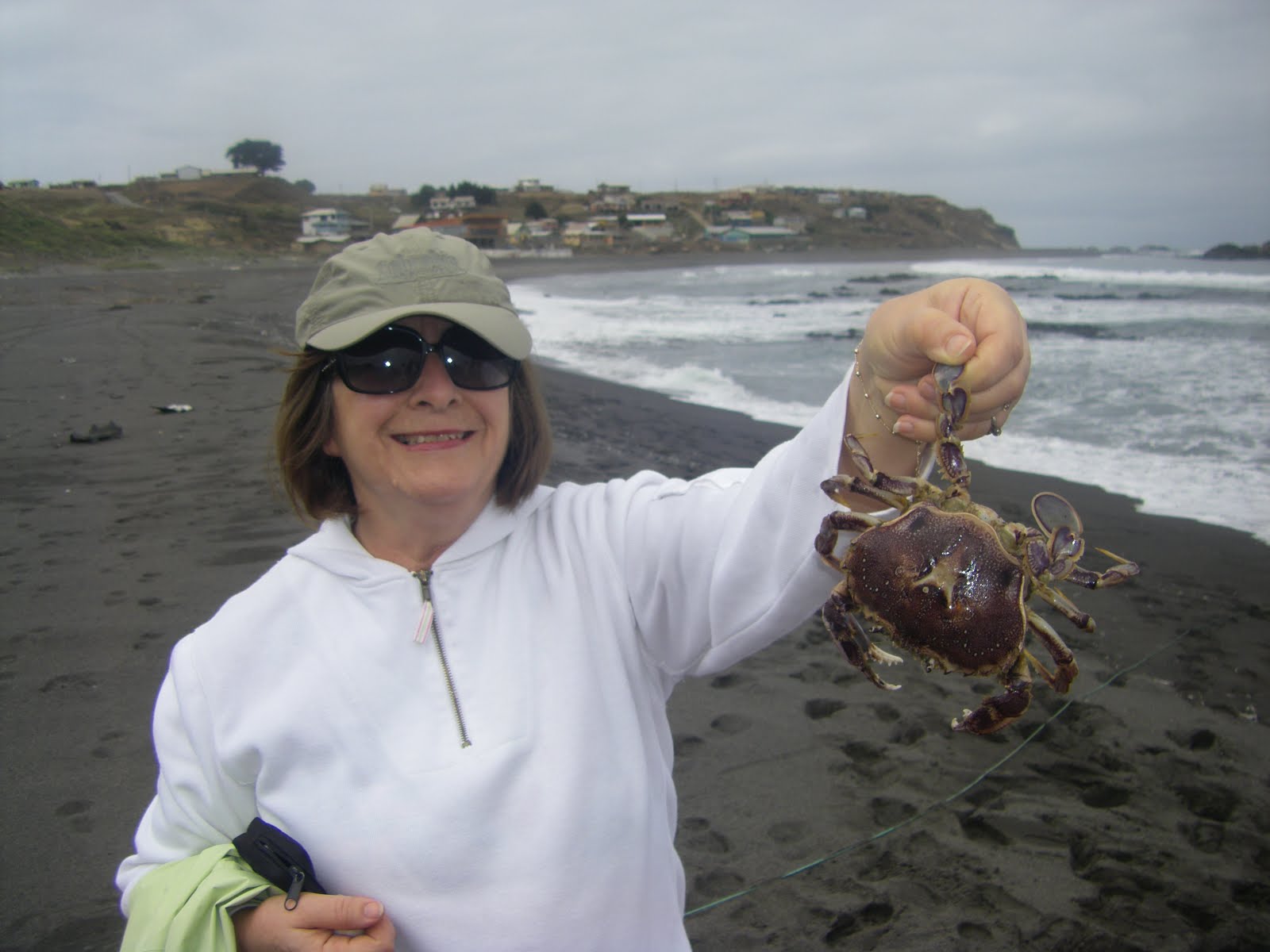
January is a most colorful and productive time in the coastal area of central Chile where the two poor but proud villages of Chanco and Loanco by some stroke of fate find themselves. The long beach that runs between the poor fishing vilage of Loanco all the way up to the foot of the Carranza lighthouse can be a seafood gatherers paradise, occasionally giving up to the alert beachcomber edible seaweed called ulte and cochayuyo, large mussels called cholgas, abelone called locos, sea urchins called erizos and delicious remadora crabs. These, combined with fried or grilled filets of sea bass called corvina and hake called merluza, are a seafood lover's dream.

Chanco is a sleepy town just 25 kilometers to the south of Loanco, and though it is right by the sea,is a mostly agriculture town. One small store in town sells the ubiquitous Chanco cheese, although most Chanco cheese sold in Chile comes from somewhere else. Chanco's Sunday farmers market in the streets of town is a show of healthy eating. This area of Maule is known for its onions, garlic, peppers, potatoes, squash, cucumbers, and during certain times of the year huge, flavorful strawberries. Of course they sell lemons, essential for pisco sours.

The best way to describe what both places provide is through pictures, pictures we took a couple of weeks ago during a visit to that lovely part of rural, coastal Chile....enjoy!


.


Posted on February 5, 2012, in Santiago, Chile.

The New Coastal Panorama of Maule

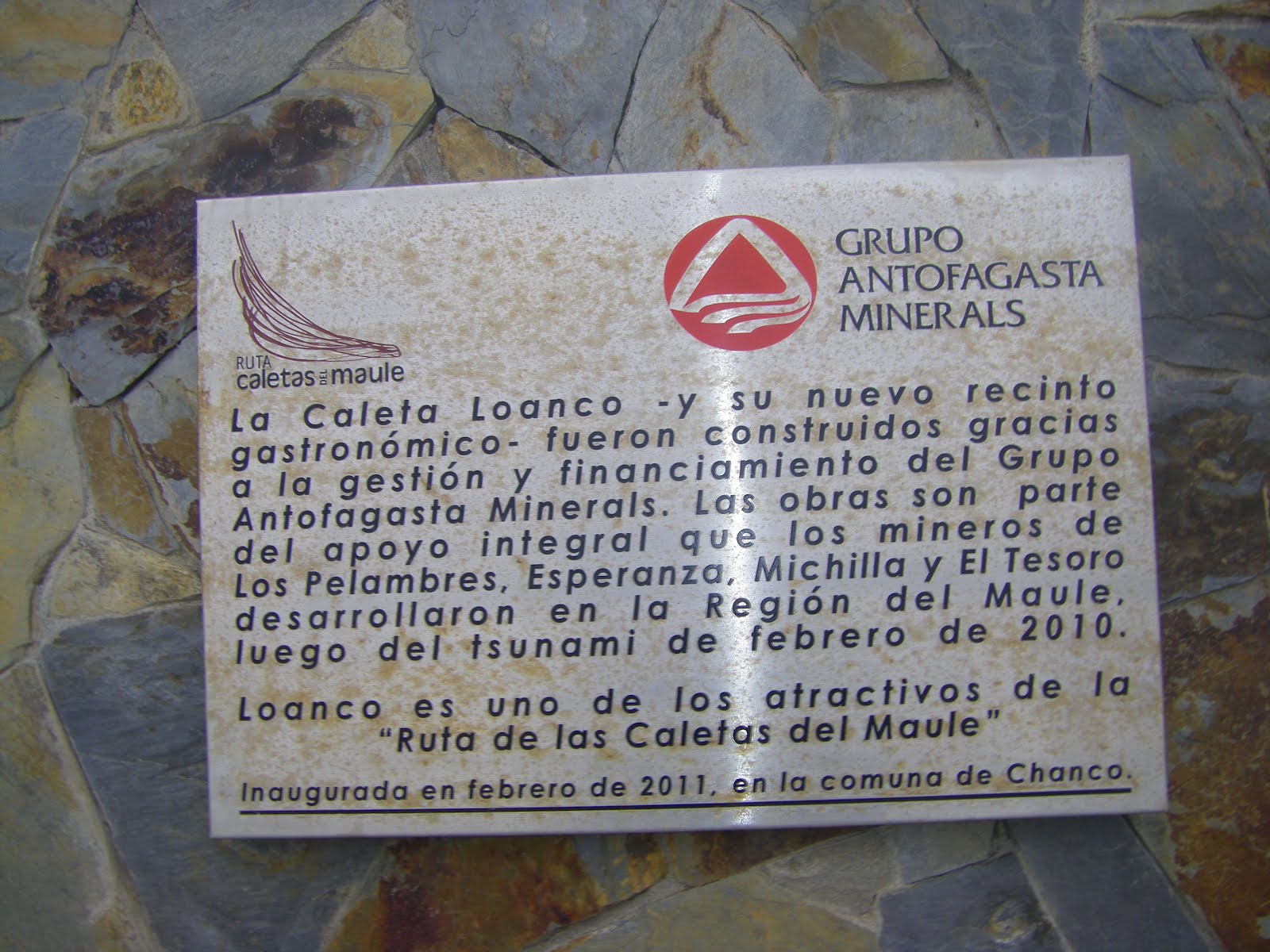
“The New Coastal Panorama of Maule", reads the title of the article in El Mercurio’s Vivienda Y Decoración magazine section that greeted us the day we arrived in Chile. Beautiful pictures of architecturally interesting buildings situated right at water’s edge in the small fishing villages of Boyeruca, Duao, Pellines, Pelluhue, Curanipe and Loanco proudly provided visual testimony of the near completion of this Ruta del Mar project. This is a notable example of one group of Chileans (Grupo Antofagasta Minerals) helping their artisan fishing brothers and sisters recover from the tsunami of February 27, 2010.
The idea was to create a series of structures in the fishing villages that would combine modern and traditional design while providing services to attract tourists and space for the artisan fishermen to store their fishing equipment and carry out the chores of cleaning and marketing their catch. I must admit to having been skeptical when this program was announced over a year ago. It just seemed too innovative, even transformational for these poorest of Chilean villages. So when I saw the pictures in this flashy, mostly “good news” magazine, all so very attractive, I felt a surge of optimism. But upon closer scrutiny of the pictures and the story, I got a different feeling, that things were not yet going as expected.

So, just a week after arriving in Chile, we set off to ill-fated Maule again to observe the earthquake/tsunami recovery process first hand. This time Ximena went along, to visit Ximena’s sister Veronica and her husband Joaquin at their home that overlooks the Pacific Ocean, with El Faro Carranza in view to the north, and my adopted fishing village of Loanco to the south. The Pan American highway, as it heads south from Santiago, cuts straight through beautiful vineyards and orchards, through the central valley towns of Rancagua, San Fernando, Curico, and then Talca. The Rio Claro flows from the Andes to the Pacific Ocean, crossing the highway just south of Talca. The tall two-lane bridge over the Rio Claro became an icon when it was totally destroyed in the 2010 earthquake. For the past two years, the rebuilding of this bridge has had the effect of a tourniquet tied tightly around this north-south transportation artery that runs the entire length of Chile, producing traffic backups and long delays. We passed alongside the collapsed bridge, on a temporary structure, recalling the enormity of the damage caused to Chile’s infrastructure in the 2010 earthquake. But, this is the last of the major road and bridge repairs required along the Pan American highway. Traffic is moving much more smoothly now, and the reconstruction of this 125 meter-long bridge is scheduled to be completed by the end of 2012. They claim this one is antiseismic. Let’s hope so.

Just past the Rio Claro we turned west off the highway and took the road that winds through first agriculture and then forested land as it crosses the coastal range and decends into Constitucion, one of the towns most affected by the earthquake and tsunami. Constitucion is still cleaning up the rubble and trying to rebuild. The Celco pulp mill, initially closed due to water damage from the tsunami, is clearly working, belching characteristically ugly, odorous smoke into the clear coastal air, but people are back to work. Rebuilding Constitution is surely one of the greatest challenges the Chileans face. Terribly convoluted issues of sorting out land ownership, approval and application of new building standards, establishing procedures to provide subsidized funding for homes and businesses, all take seemingly endless weeks and months to work out. The area along the river, totally destroyed two years ago is still awaiting resolution of these issues, showing little progress to date. If I were to suggest it would take 8 to 10 years to get Constitucion back on its feet I could be accused of being overly optimistic.

In the face of this challenge, though, there is one encouraging story to be told: the rebirth of “Cabanas Playa El Cable”. Three kilometers down the narrow road that runs south along the coast from the beach area of Constitucion to a fishing pier originally built to service the Celco mill, is where Guillermo and Javiera lost their home and their tourist business (cabins and restaurant) to the tsunami. Their story has been told in part in earlier postings on this blog (See April 26, 2011 posting ). We decided to pay them a visit, before going on to “El Faro”, to see how they were progressing with their rebuilding, and if feasible, arrange to stay overnight the next Sunday on our way back to Santiago.

When we drove down to the parking area, Guillermo and Javiera dropped what they were doing and rushed to great us. Proudly pointing out the now 20 cabins finished and ready for occupancy, the pool area already being used, and the attractive two-story restaurant, they assured us we would have a cabin to stay in Sunday evening, the restaurant would be open for dinner, and they would tell us all about how they were doing.

So, we moved on down the coast, almost jubilant from having seen Guillermo and Javiera so excited about the progress they have made. We bought several merluza filets at a roadside stand and drove to Veronica and Joaquin’s home, called “El Faro”. We unloaded our bags from the car, and immediately joined Marira and George (Veronica and Joaquin’s daughter and Scotch/Chilean husband), who had prepared slices of mild Chanco cheese, spicy salame, and pisco sours for the “El Faro happy Hour”. We sat on the porch and marveled at how pacific the Pacific Ocean was, not a normal condition, and how low the water was around the long rib of rocks protruding into the ocean from the shore near where the Carranza lighthouse is. This group of rocks is inhabited by hundreds of sea lions (called “lobos” locally), and this afternoon, without the normal high winds and rough surf, the lions produced a din so loud (and an occasional whiff of guano so strong) they seemed to be right next to us.

With the dust from our journey from Santiago finally washed from our throats, we drove to the small fishing village of Loanco, to meet Veronica and Joaquin for dinner at another “adopted” place, Restaurante Las Rocas, the rebuilt seaside restaurant owned by Maria and Dago (also the subject of earlier postings in this blog). As we drove down the hill into town, a weird feeling hit me. I knew why immediately, but I didn’t say anything. I was trying to rationalize what I was seeing, but to no avail. There were no boats in Loanco!
No boats, no tractor to pull them out of the water, no flocks of seagulls picking over piles of discarded fish, no dogs running around, no refrigerated trucks loading fish, and most noteworthy..no fishermen. I was shocked to say the least. But not too shocked to have a nice dinner of abalone (“locos”)fried merluza and corvina, and a generous amount of Misiones de Rengo sauvignon blanc


Incredible as it may sound, the artisan fishermen of Loanco, with their new boats and motors made possible by donations received after the tsunami destroyed everything they had, have decided to move their boats out of Loanco, 7 kilometers up the coast, to a spot they claim is more appropriate for launching and landing their boats. No matter, apparently, that the new Ruta del Mar installation has now been finished and is ready to be put into operation. So, Loanco's shores are desolate, and the new restaurant, equipment storage and fish processing facility stands vacant. Unbelievable, but true.


The next day, Ximena and I checked out the new Ruta del Mar facility at Pellines, just a few kilometers up the road from Loanco, also featured in the El Mercurio V&D magazine. .
Here also, the new facility is finished, but closed. Reason? Paperwork for operating the restaurant has not been finalized. So, in the middle of summer, the tourist season, this establishment also just sits and waits for someone to do something. The fate of these much acclaimed facilites in Loanco and Pellines remains uncertain, but while an optimist would suggest everything will eventually work out, I am of the mind that a lot of thought went into the design of the "Ruta del Mar" facilities, but far too little attention to the business and implementation side of the project. It seems like these facilities were just turned over to a group of fishermen and their families with little concern for who would be in charge and how they would operate the business. We


returned to Constitucion to spend the night at Guillermo and Javiera's lovely seaside cabins. Over cold pisco sours, pastel de jaiva,(crabmeat pie) grilled reineta, and some Concha y Toro Sauvinon blanc Reserva, we talked about how they were able to rebuild their business. It seems that their location so close to the sea prohibits insurance that is required for normal business bank loans, so they have had to scratch for capital. But little by little, they are making it. The night we were there the cabins were mostly occupied. They want to hook into tourism agencies with US and European clients, but so far are benefiting mostly from word of mouth to market their place. Soon they will build their new home up on a bluff above the cabins alongside the road. The old one was wiped out by the tsunami, and the new restaurant has been built on that site. It's not easy for Guillermo and Javiera, and it is not clear that they will be able to capture a reliable flow of guests to continue to improve and expand their business, but the energy and persistence with which they are going forward, with very little help from official relief programs, is encouraging.

So there you have it; three post-tsunami projects: Restaurante Las Rocas, Cabanas Playa El Cable and Ruta del Mar. Two moving ahead through the perseverance and hard work of committed entrepreneurs, Maria and Dago, Guillermo and Javiera, and the other stalled due in part to uncertain management responsibilities and capabilities, and ineffective involvement of local public sector agencies and bureaucratic lethargy. After an event like the Chilean tsunami, it is not easy to get businesses back operating and people back to work. But it is essential. Small businesses are the lifeblood of towns like Loanco, Pellines, Chanco, and Constitucion. To get them going again requires access to capital and temporary relief from taxes on small business. Support from government to decrease regulatory hurdles helps, but as these three cases prove, finding your own source of capital and simply moving ahead with the rebuilding process without waiting for public or private assistance seems to work best. In fact that is what Guillermo says he suggests to his small business friends.."just get going! Don't wait for help. If it comes, all the better. But don't wait for it."


Posted on February 5, 2012, in Santiago, Chile